

Draining and Damming the Swamp
Two mythically connected matters were reported on the same day. Donald fake-explained why Russia failed to take Kyiv. Russia bombed the dam that keeps Europe’s largest nuclear power plant safe.

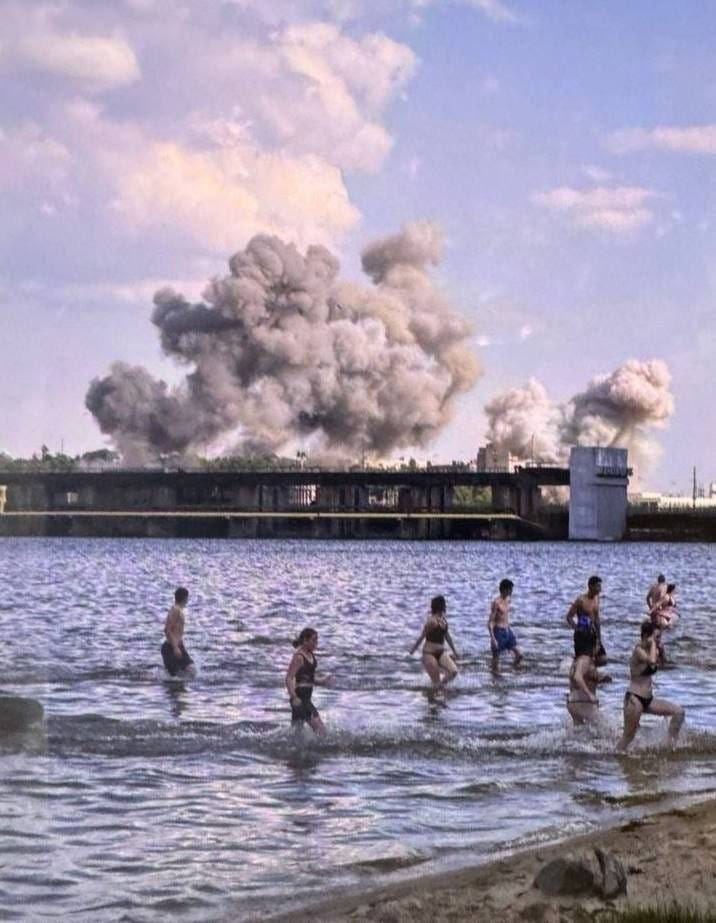
Donald Trump fake-explained why Russia failed to take Kyiv at the start of the war as a piece of Russian incompetence: a Russian general, he said, drove the tanks into a swamp because he would not take the highway, and that one mistake turned three days into four and a half years. And on the same day, Russia put guided bombs into the great dam at Zaporizhzhia again. Set the two reports side by side and they are the two halves of the oldest story we have. On that one day we watched one half of it erased, and the other half committed.
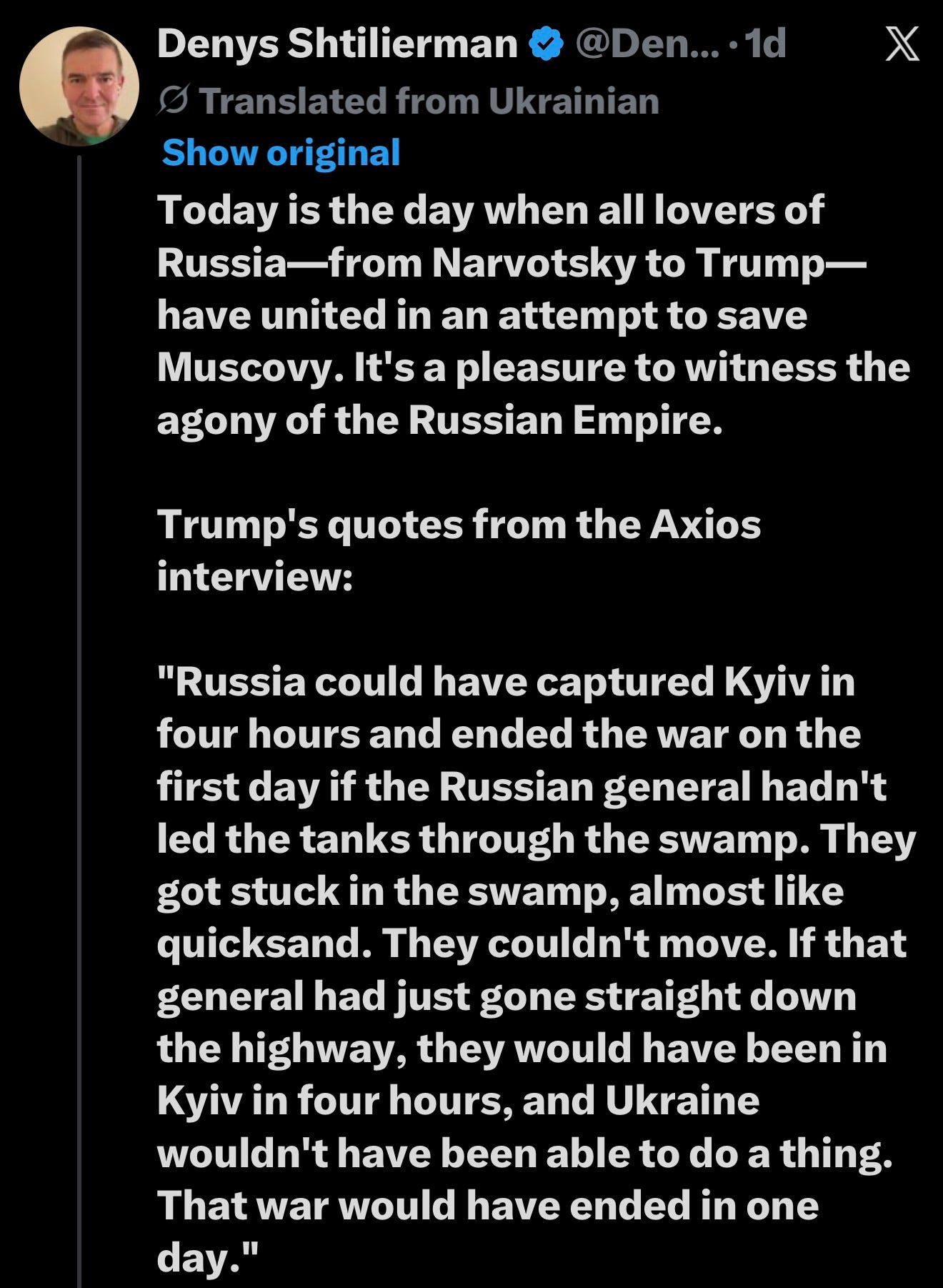
Begin with the swamp, because the word is doing quiet work, and there is more than one swamp hiding inside it. There was indeed a swamp in front of the Russian armour to the north-west of Kyiv in the last days of February 2022. It was not there by nature, and it was not there because a general blundered. It was there because Ukrainians put it there, on purpose.

On the twenty-fourth of February the columns crossed from Belarus and came south, down the most direct road from Chornobyl through Hostomel, where Russian paratroopers had landed that morning to seize the airfield. The plan was to reach Kyiv in about seventy-two hours. Between the armour and the capital lay the Irpin, a small slow river that runs north to south through a wide floodplain west of the city. In late February that floodplain was frozen hard, and hard ground takes the weight of a tank.
On the night of the twenty-fourth, and through the twenty-fifth and twenty-sixth, a small group of Ukrainian engineers and territorial-defence men, working under the authority of their state, demolished the Kozarovychi dam on the Irpin upstream of Kyiv and breached several other structures along the river. The stored waters came out across the floodplain. Under the volume of water the frozen ground thawed, and within forty-eight hours it had turned into an impassable marsh of mud and ice-melt. The armour that had been racing south could no longer cross. The seventy-two-hour plan failed. By early March the columns were jammed along the highway, easy prey for drones and mortars and ambush from the woods, and by the end of March the Russian forces had pulled out of the north of Ukraine entirely.
The man chiefly behind the demolition was, by the documentary record, a Kyiv businessman with demolition expertise, known in the West Point Modern War Institute’s careful account of the Battle of Kyiv by the working name Andriy; his real name is kept back for his own safety. On the morning of the invasion he used a senior contact to win a same-day meeting with General Oleksandr Syrskyi, then commanding the defence of the Kyiv region. On Syrskyi’s authority he was issued close to a tonne of explosives. He drove out with his stepfather and two colleagues to the dam where the Dnipro reservoir meets the Irpin, and he blew it. The floodplain flooded. The advance from the north stalled. Kyiv held. Two minutes of work at a threshold, and decades hang on it.
I want to be careful here, because the truth is strong enough without being stretched. A great many things went wrong for Russia on that northern axis. The forty-mile convoy stalled for want of fuel and food. The airborne assault on Hostomel was thrown back and the airfield denied. Ukrainian ambushes bled the columns in the lanes and the woods. I am not telling you that one man with a tonne of explosives won the Battle of Kyiv by himself. I am telling you something narrower and harder to argue with. The swamp in the story was not a swamp. It was a flood. And a flood is not weather, and it is not a clumsy general’s bad luck with the mud. A flood like that is a thing a people does. Ukraine did not get lucky with the ground in front of Kyiv. Ukrainians released the waters.
That act has a shape, and the shape is the oldest one we know. In the Rigveda, the oldest book in any of the languages you and I speak, the god Indra goes out against the dragon Vritra, who has coiled himself around the waters and dammed them at the source so that the world lies in drought, and Indra kills the dragon, and the waters are loosed, and life comes back. The comparativists who study these things have traced that same dragon-slayer through every branch of the family: Thraetaona against Azhi Dahaka in old Iran, Thor against the world-serpent in the north, Apollo against Python and Heracles against the Hydra in Greece, Lugh against Balor in Ireland, Perun against Veles among the Slavs, Saint George against the dragon in England. And the hero, in the oldest layer of it, is the third. Trita, in the Sanskrit, means “the third one,” the small late-coming actor who wins where the first and second heroes, the great ones, the heroes of sheer power, have tried and failed.
The waters in that story are not water in general either. They are the rivers that still carry the oldest word our languages have for a river, the word the scholars write as Danu. You can hear it now in the names of Ukraine’s great rivers: the Don, the Donets, the Dnipro, Dniester, the Danube. The story was first told on those very river valleys, on the steppe that is now Ukraine, before two and a half thousand years before Christ. So when a Ukrainian named Andriy let out the waters of the Irpin, which is a tributary of the Dnipro, to turn back an army, the oldest story in our languages was being acted out on one of its own first rivers, by a man who happened to carry one of its own oldest names. He had surely never heard of Trita. He did not need to have heard of him. The story is the floor under everyone who speaks these languages, and he reached for it the way you reach for a rail in the dark, without looking, because it was there.
And on the very day the swamp was being explained away as a Russian mistake, Russia was performing the story’s other half. At Zaporizhzhia it drove guided bombs into the DniproHES, the largest dam in Ukraine, the dam whose power cools the largest nuclear station in Europe. It is the thing Russia did fully at Kakhovka in June 2023, when it destroyed the dam on the lower Dnipro and sent eighteen cubic kilometres of water down the river, drowning seventy-six settlements, killing at least fifty-eight people outright, and, as the reservoir emptied, laying bare the best-preserved site of the very people who first tamed the horse on that river. That is the dragon’s move, exact and entire. Not the hero who frees the waters for the living, but the serpent who hoards them and then breaks the wall so the flood comes down on the living. Andriy let the waters go to save people. Russia lets the waters go to kill them.
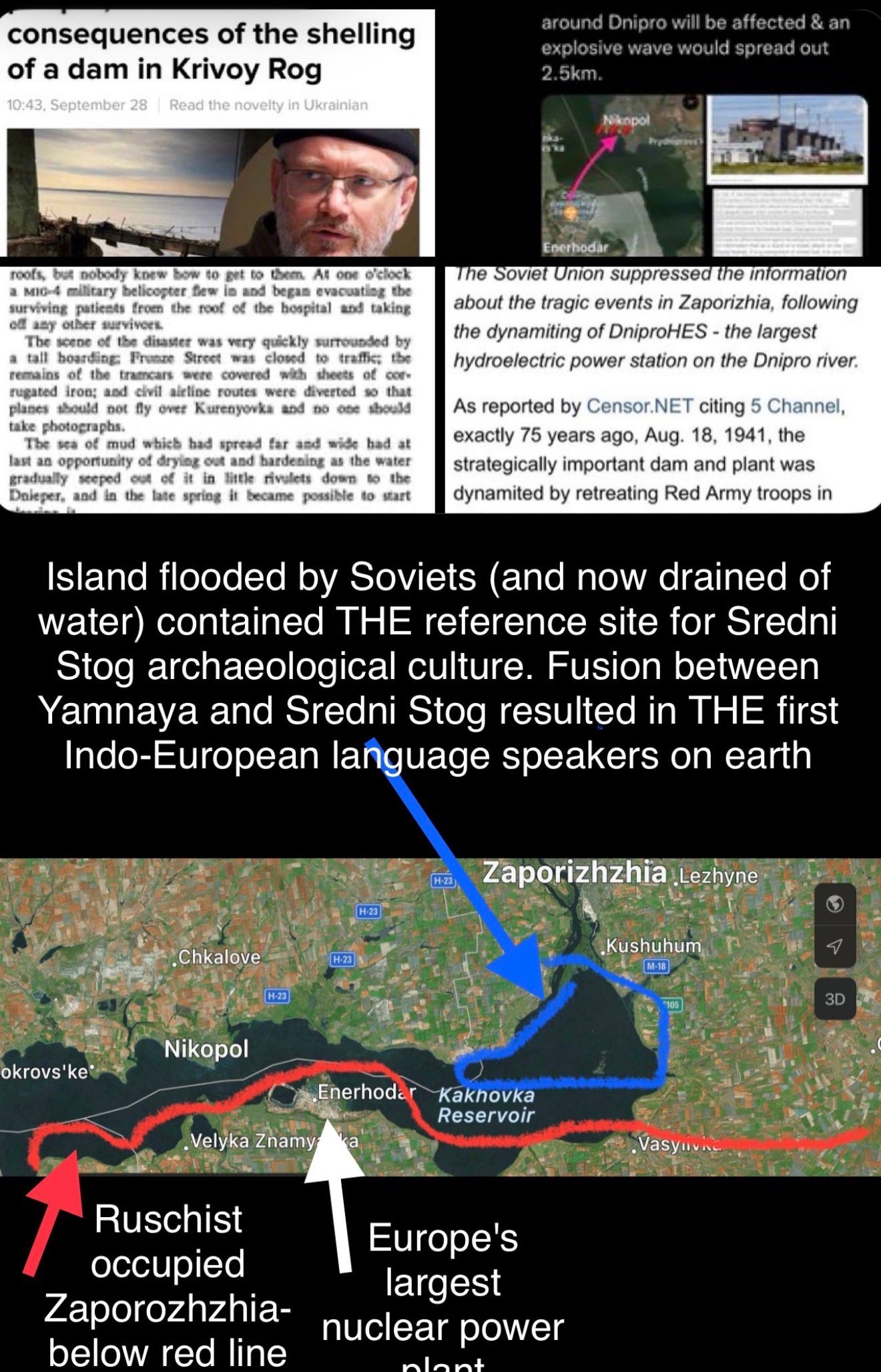
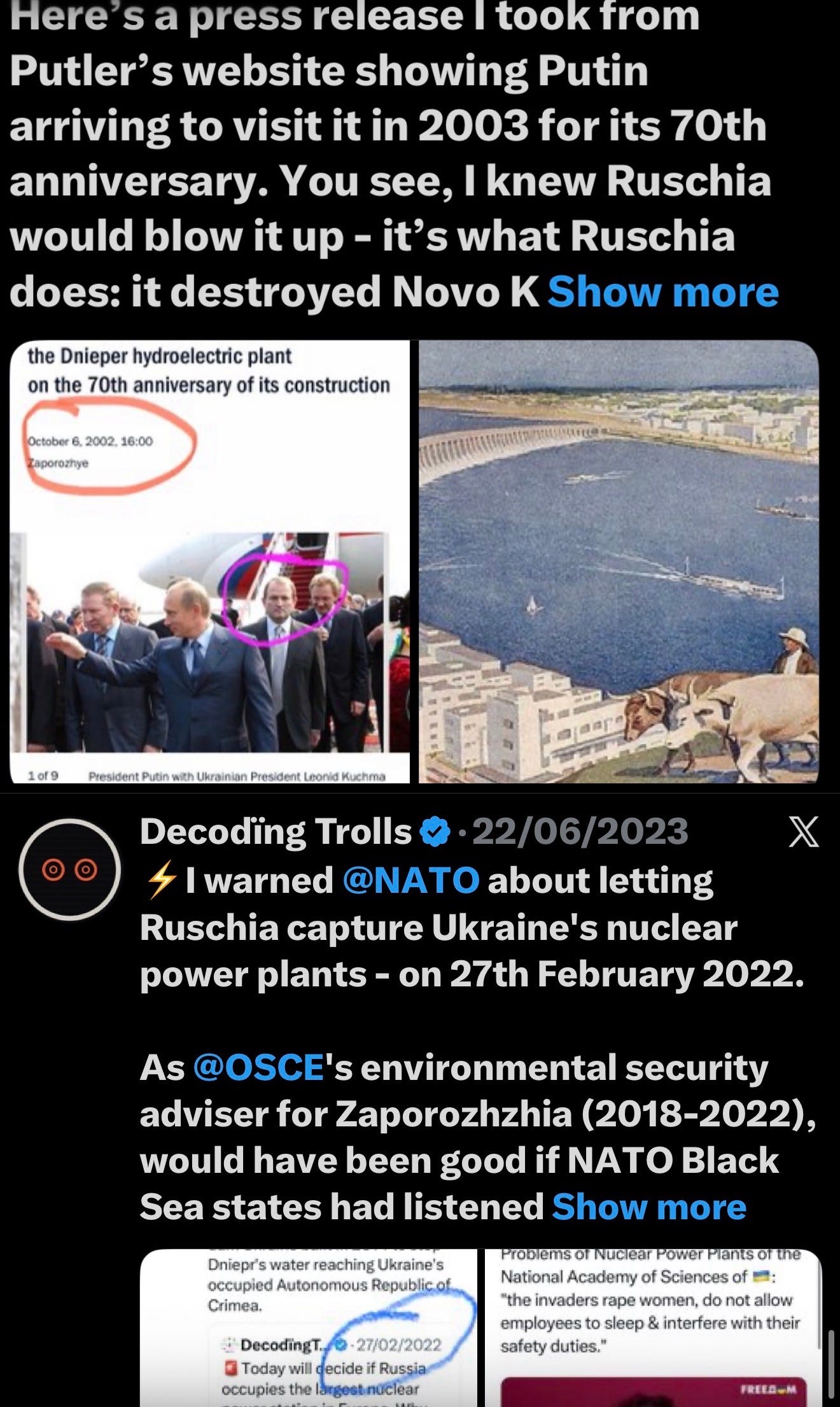
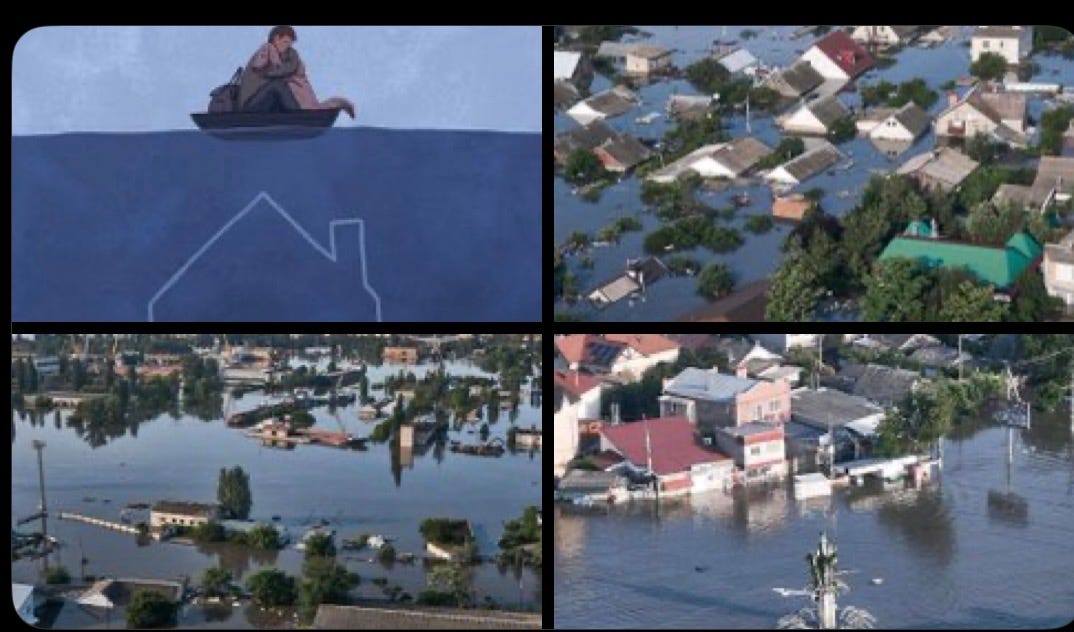
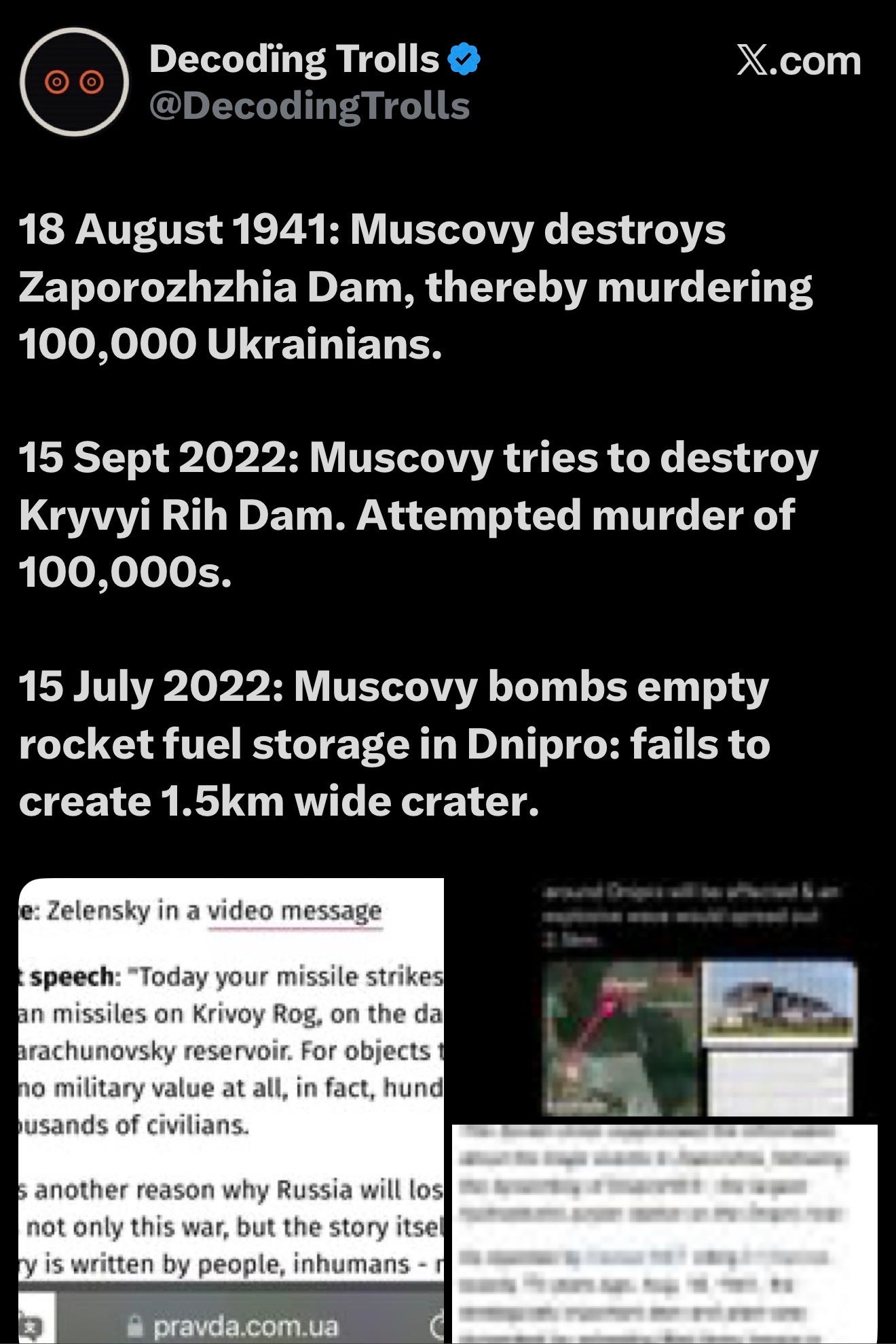
It is wrong by the oldest law we have, the one the story itself carries, in which the waters belong to life and the one who hoards them and turns them into a weapon is the dragon the hero exists to kill. And it is wrong by the newest law as well, the Protocol we added to the Geneva Conventions once the World Wars had shown us enough, which names three works that may never be made a target, however the attacker dresses it up, because to break them is to loose forces no soldier can call back: dams, dykes, and nuclear power stations. At Zaporizhzhia, Russia reaches for two of the three in a single strike.
Now go back to the swamp, because the way we tell this is not a small thing. To say that Russia failed at Kyiv because a Russian general was a fool is to tell the story with the hero cut out of it. It says that Ukraine did nothing. It says there was no Andriy, no same-day meeting, no tonne of explosives, no waters released on purpose, only a clumsy giant who tripped in the mud he should have walked around. I will not pretend to know what Donald Trump pictures when he says the word swamp, and it does not matter, because whatever he pictures, the thing on that road was a flood that Ukrainians made. And the framing he reached for, whatever he meant by it, happens to be the exact story the apparatus in Moscow most wants the world to hold: that Ukraine is not an actor but only a place where things happen to Russia, that there is no agency on the Ukrainian side worth naming, that Russia, even beaten, is the only one with a hand on events.
It is the same erasure, run twice in one day. In the swamp it takes the hero out of the founding story. At the dam it lets the serpent commit the founding crime while the world is busy looking at a peace plan. And the reason it matters which way we tell it is that the story is how we tell them apart. Take the agency out and you can no longer tell Andriy from the general, the flood that defends from the flood that drowns, the third hero from the dragon. The whole use of keeping the oldest story is that it holds those two apart, and names which is which.
And there is one last turn in that word, swamp, and it is the sharpest. Ukrainians have long called Moscow a swamp, and not only to insult it. The city was raised on marshland, and the thing it houses is exactly what a swamp is: water that has been dammed and hoarded until it stops moving and goes bad. A swamp is the dragon’s own element. It is the opposite of the living flow the hero lets out. So the man who once promised, before all else, to drain the swamp has ended by pointing at the wrong one entirely. He has not drained the swamp in Washington that he named. He will not go near the swamp in Moscow that fills the body bags. The one swamp he can bring himself to see is the one that was never a swamp at all, the bright cold flood that a Ukrainian let out across a floodplain to hold the swamp’s own army back. He has it exactly inverted. The flood was the thing that, for a few weeks on one front, actually drained the swamp.
So let us put the hero back where he stood. The swamp was a flood, and a man the records call Andriy made it, with his state’s blessing and his stepfather beside him, and it bought Kyiv the hours it needed. That is the third hero’s move, performed in our own time on the river where the move was first imagined six thousand years ago. Ukraine has shown that it still knows the oldest task there is. The rest of us who say we believe in Never Again have only to give Ukraine what it needs to finish it, and to refuse, every single time it is offered to us, the comfortable lie that there was never any hero at the water, and never any serpent at the dam.
