

⚡️The Powerless Tyrant
Carnegie has a new word for complicity: “depoliticization.” A Ukrainian historian has the right ones.

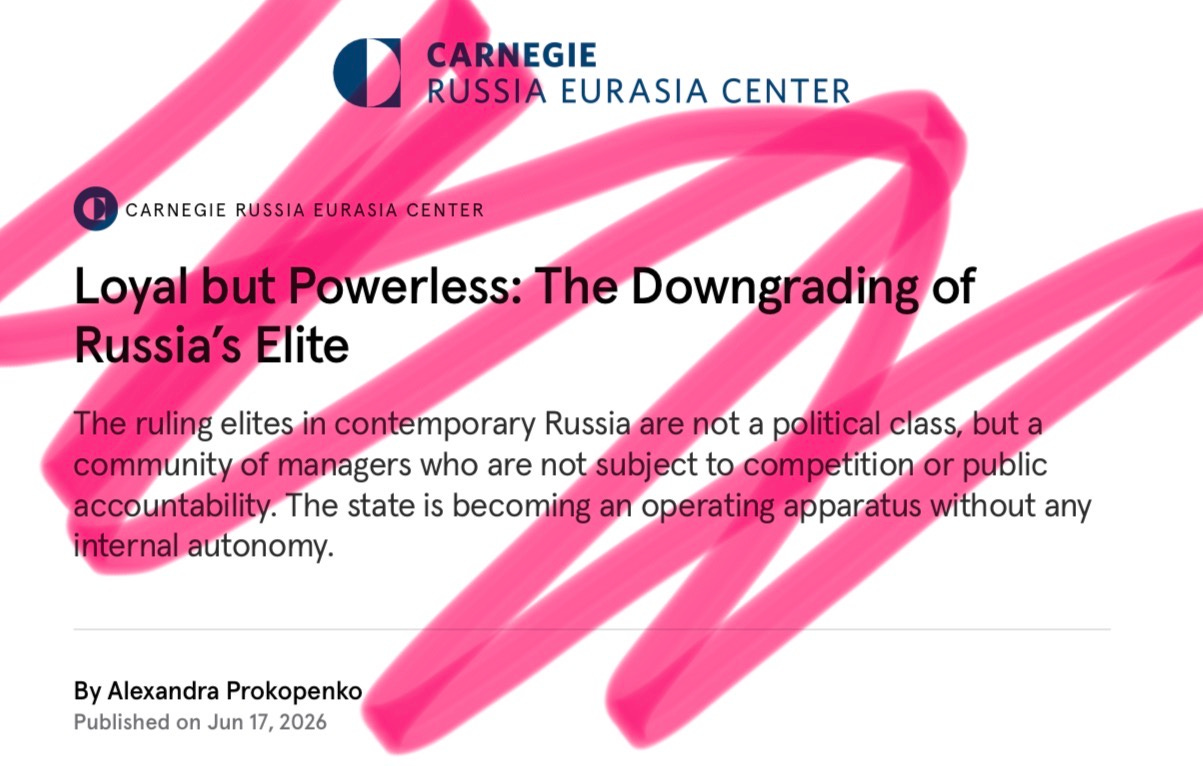
On 17 June the Carnegie Endowment published a paper by Alexandra Prokopenko, “Loyal but Powerless: The Downgrading of Russia’s Elite.”
It is careful, well-sourced, scholarly — and within a day a second Carnegie fellow, Tatiana Stanovaya, was urging everyone to read it:
“one of the most consequential studies of Russia’s wartime elite to appear since the full-scale invasion,” offering “a remarkably informed view from within the system,” with “insights that are simply unavailable elsewhere.”
Hold on to that phrase. A view from within the system.
We will come back to who is doing the viewing, and why “within” is being sold to you as a credential rather than a warning.
First, what the paper does — because it is worth decoding, not for who wrote it but for what it performs. A troll does not need a liar to carry it. It needs a respectable institution and a plausible word.
The paper’s claim is that the Russian elite did not resist the invasion of Ukraine, and that this failure “is not the result of personal weakness or cowardice.
It is the systemic result of a quarter-century of depoliticization.” The two or three hundred people around Putin are renamed, with a Latin flourish, as nobiles — a Roman aristocracy who had “access” but, we are assured, “access is not the same as influence.” Depoliticization, the paper says, “turned a group of people with resources and intellect into a herd that now simply implements the technical tasks that the regime puts in front of it, seemingly devoid of any agency.”
A herd. Devoid of agency. Nobody is driving.
You have heard this before — not from a think tank, but from the apparatus itself. None of this is on me. I’m a small person in a vast river. I didn’t start the war, I don’t make policy, I just live here. Judge the Kremlin, not me. In our work we call this the Distributed Tyrant: the absolute ruler smeared so thinly across forty million shrugging shoulders that no single shoulder feels the weight. The Carnegie paper is the seminar-room edition of that troll. Same energy, better footnotes.
Now set beside it another book about the very same regime.

Laryssa Yakubova is a historian at the Institute of History of Ukraine of the National Academy of Sciences. Her 2023 study Ruscism: The Beast from the Abyss runs to three hundred pages, and she writes like a prosecutor with a poet’s ear. “There is no great russia,” she hammers, “there is a frenzied barbarian tribe.
There is no great russian army — a criminal grouping of rapists and marauders. There is no great russian culture — a bankrupt cabinet of curiosities of dead memes.” Where Prokopenko reaches for “depoliticization,” Yakubova reaches for a word she had to build. Genocide is not large enough, so she borrows ontocide — “the total annihilation of all that exists, war with being as such.”
Read the two registers side by side and you see the whole problem.
In Prokopenko’s report the word genocide does not appear once. Neither does “war crime,” “atrocity,” “Bucha,” or “Mariupol.” The word structural appears eight times. A paper about the people who ran Russia’s war manages never to name the war’s nature, and names “structure” instead at every turn. That absence is not an oversight. It is the method.
The whole argument turns on one question: did they choose?
Prokopenko’s answer is the keystone of the entire exculpatory architecture: the elite’s conformity
“is therefore not an aberration or down to the individual character of its representatives, but the structural result of institutional design.”
Agency is written out and posted to impersonal design. No one inside the system can be blamed, because the system explains them completely.
Yakubova’s answer is the exact reverse, and she states it without flinching. “One is very mistaken,” she writes, “who considers the people enslaved by the components of this system… The stable 4/5 of the population… are its demographic base and co-author.” Co-author. Not hostage, not herd — author. “Imperceptibly to the russians themselves,” she goes on, “they ‘tied’ themselves with the blood of Ukrainians and made themselves collective accomplices in a crime against humanity.” Where Carnegie sees a structure that happened to people, Yakubova sees people who, choice by choice, built the structure and then loved it: “The people ‘recognized themselves’ in the collective putin. They recognized themselves and took pride. They took pride and loved with sincere love.”
Here is the part that should embarrass the Carnegie Endowment title. “Loyal but powerless” is not Prokopenko’s discovery — Yakubova got there first, and meant the opposite by it. On nominally their own land, she writes, the Putin electorate is “absolutely powerless,” and then comes the line no reader forgets: “To feel themselves ‘supermen’ fell to them only with unarmed Ukrainians.” Same powerlessness. But where the report uses it as an alibi, the historian follows it down to its monstrous compensation — a people impotent at home that discovers its only taste of power in cruelty abroad. She even dates the surrender: “so-called learned helplessness begins already at the 30-year mark.” The powerlessness is real. It is also chosen, and the regime converts it into violence. That is the analysis the report had every piece for and declined to make.
What “a view from within the system” actually looks like.
The report’s evidence is a sequence of confessions, quoted warmly and left unanswered. A deputy minister recalls requisitioning land: “At first, such talk seemed a bit barbaric, but then I got used to it. It’s only a job, at the end of the day.” A technocrat explains why he stayed after the invasion: “I see no job that would offer more interesting work for an economist than the post I hold right now. We’re at the epicenter of a vast structural transformation of the economy.” On the annexation of Crimea, the report records “an enormous amount of follow-on bureaucratic work” — and, in a subordinate clause buried between tax revenues and a new ministry, that “Ukrainian citizens and companies on the peninsula had their property confiscated,” which “did not spark any internal conflict within them, since they were simply following orders.” Simply following orders, written down in 2026 without irony.
This is the Distributed Tyrant in field-notes. Every confession is allowed to stand as data about the speaker’s feelings, never once measured against the man being tortured a few hundred kilometres away. The victims are not disputed in this report. They are simply absent.
Which brings us back to who is doing the viewing.
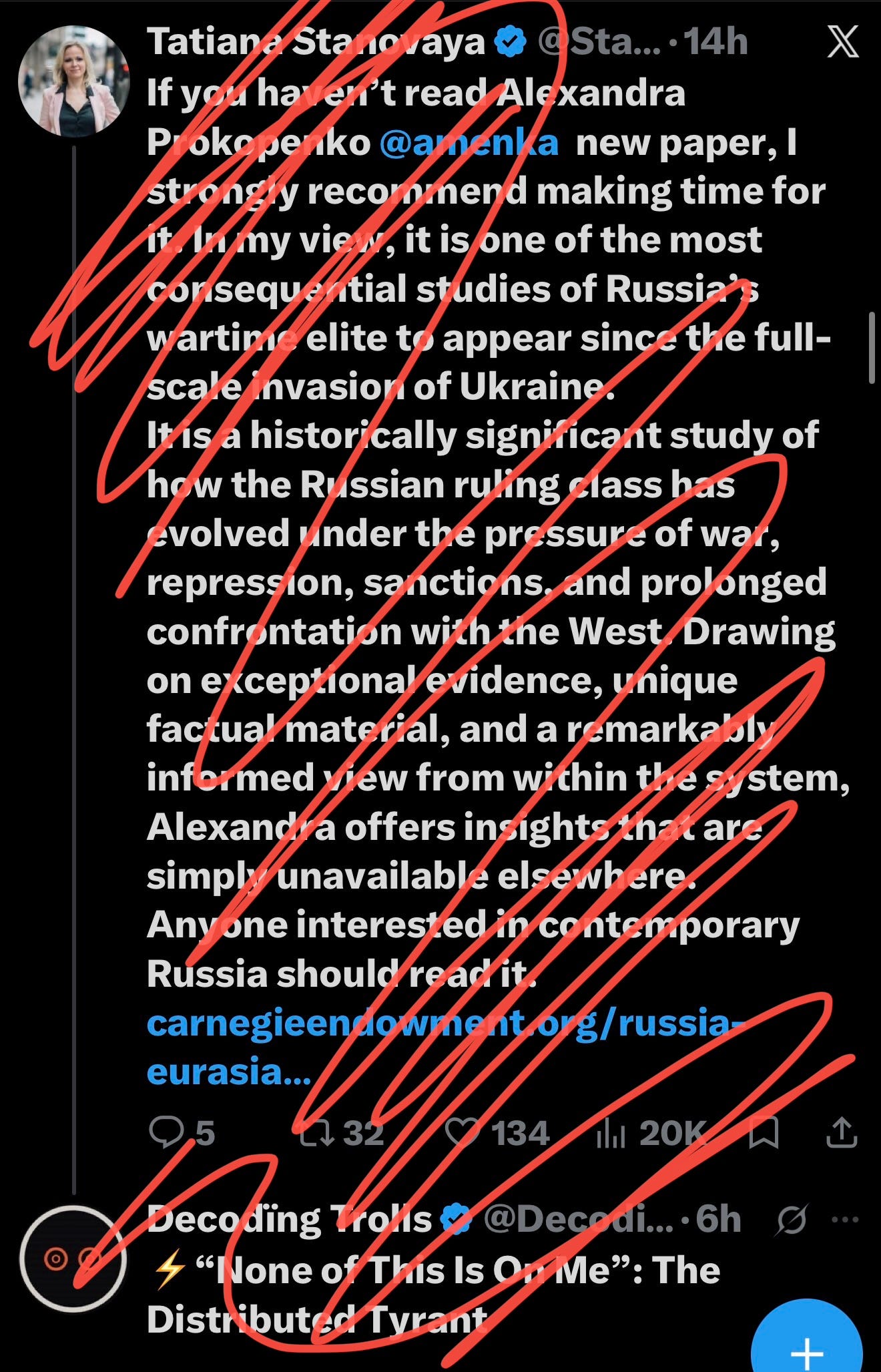
Tatiana Stanovaya, who told the world this paper was essential, is herself a senior fellow at the Carnegie Russia Eurasia Center — the same center that publishes Prokopenko, a fellow there and a former adviser at Russia’s central bank until 2022. One Carnegie fellow crowning another Carnegie fellow’s Carnegie paper, and selling you the author’s nearness to the apparatus — “a view from within the system” — as the reason to trust it. But nearness to the machine is the affliction this paper suffers from, not the cure it offers. Carnegie has form here. For years its Moscow Center was directed by Dmitri Trenin, who after February 2022 surfaced as one of the establishment voices articulating the war’s real legal payload — the re-establishment, in his phrase, of “the supremacy of national legislation over international treaties,” which is the whole project in a single clause. A Western institution lent that man its patina for decades. Now its network gathers to amplify the next one.
And here is the part that should unsettle anyone who assumes the danger left Russia with the émigrés. Prokopenko is not a Kremlin mouthpiece. She left; she is in the West; she sits at Carnegie with no security service at her shoulder. Name a meme by what it does, not by what its author feels — and judged that way, this is the more disturbing case, not the lesser one. The apparatus’s own story — none of this is on me — no longer needs the apparatus to carry it. It reproduces itself through people the Kremlin no longer controls, inside the institutions the Kremlin most wants to reach. That is what a deep troll is: not a paid lie, but a frame built so well that free people rebuild it for free.
Yakubova has a name for that kind of “freedom” — the kind that changes the wallpaper and keeps the house standing.
She calls it a reboot, and sets it against metanoia, a real change of mind, “a root-and-branch reconstruction of social practices.” The reboot is the cosmetic kind: “a switching off of the towers, a rewriting of history textbooks,” the ritual repentance “after which there follows neither punishment, nor comprehension, nor atonement.”
“The rebooting of a totalitarian system,” she writes, “has as its consequence that same totalitarian system.”
The “we were all powerless” story is the reboot’s advance guard — the script for sanctions relief, for the Marshall plan that arrives instead of the reckoning, for mercy extended to people who were, you understand, never really there. A powerlessness paper written from safety and amplified by a Western network is a reboot with footnotes.
Same inheritance. Opposite choice.
Russians and Ukrainians came out of the same Soviet wreckage. Carnegie says that inheritance produced a herd with no agency. Then explain Ukraine — and here Yakubova’s prose lifts into something the report could never reach. She describes “Berdiansk-folk, Melitopol-folk, Kupiansk-folk and Sumy-folk, not rarely women and villagers,” who “stop enemy columns, expelling them from their own land without weapons.” A mother stands one-on-one at a Russian checkpoint, her children in the car, and reads the occupiers the Constitution of Ukraine. “This is an epos!” Yakubova writes. “The epos of the nation in the fullness of vital force!” I have stood in one of those squares. In Dnipro, as an OSCE monitor, I watched perhaps a thousand ordinary citizens convene a veche — the old people’s assembly of our shared inheritance — and burn a white flag of surrender. Vitaliy Oleshko (callsign: Sarmat), a veteran who would not stay quiet, was shot dead for it in Berdiansk in 2018. A Moscow technocrat who objected risked a dacha. Oleshko paid with his life.
The agency was always on the shelf, at every price up to and including death, and Ukrainians bought it. The Russian elite looked at the same shelf and chose acquiescence — and the choice of acquiescence is still a choice.
So we are being short-changed, and it is worth saying plainly. The Western reader is handed the insider’s managerial frame, amplified by Carnegie’s own people, while the historian who actually names the thing — ontocide, co-author, the lie that binds dictator and people into one “symphony” — goes untranslated and unread. One book studies how the managers of a genocide came to feel comfortable. The other mourns the Greeks of Mariupol, “a unique people… being wiped from the face of the earth,” and asks what is owed. Yakubova puts her whole ethic in two sentences:
“One will have to call things by their names. In order to give a meager chance for at least someone to exit from the mirror hall of perfected evil.”
That is the opposite of finding a new word for complicity. And it matters now, because the bill is about to come due. As I write, Ukraine is besieging Crimea — not with an army on the isthmus, but by strangling its supply routes, a siege “in the modern sense,” isolation that is already draining the peninsula’s fuel. In March 2022 I made a prediction: as Ukraine moves closer to retaking Sevastopol, Crimea, and the bridge across the Kerch Strait, “anti-imperialist” and self-declared “leftist” voices will cry Versailles! Versailles! That chorus is tuning up, and “Loyal but Powerless” is its sheet music — the scholarly proof, filed in advance, that nobody on the Russian side could have done otherwise, so nobody on the Russian side should have to answer.
Read the other book. Yakubova does not run a country across eleven time zones, and she does not need a new word for what its rulers did — she has the right ones, and she uses them. The powerless do not bomb maternity wards and draft the next decree before the rubble cools. Agency that can do all of that can also stop. The mother at the checkpoint knew it. Oleshko knew it, and died of it. Carnegie knows it too — which is exactly why it needed a new word.
That was an excellent comparison of those two works and of the myths about the "powerlessness" of russians.
Is this the best link for the Ruscism book?
https://akademperiodyka.org.ua/en/books/ruscism/