

Why I think the Lunin video is staged
The Walk-In is the oldest device in storytelling. The stranger who arrives from outside with an urgent message that changes the plot. Russian information operations use Walk-Ins like Lunin a lot.

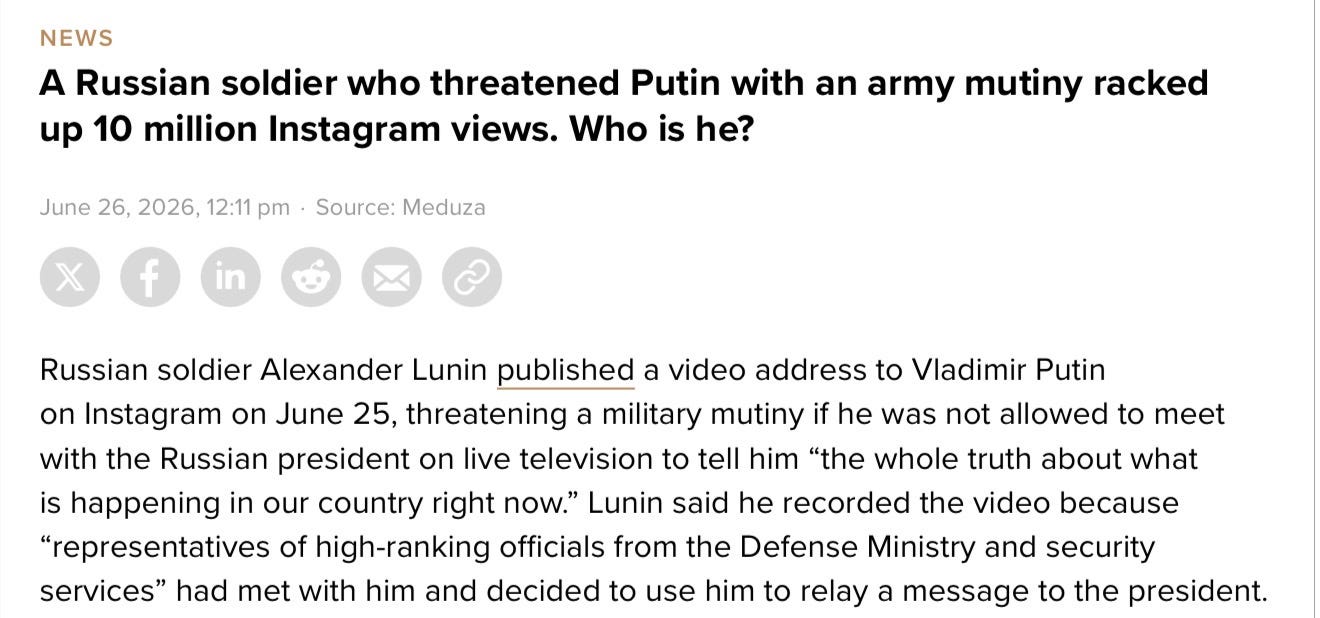
Here’s why I think this viral Lunin video is staged by Russia’s security services.
I’m not the only one to be sceptical about the provenance and meaning of this video and sequels which peppered Russian and the pro-Ukraine information space today.
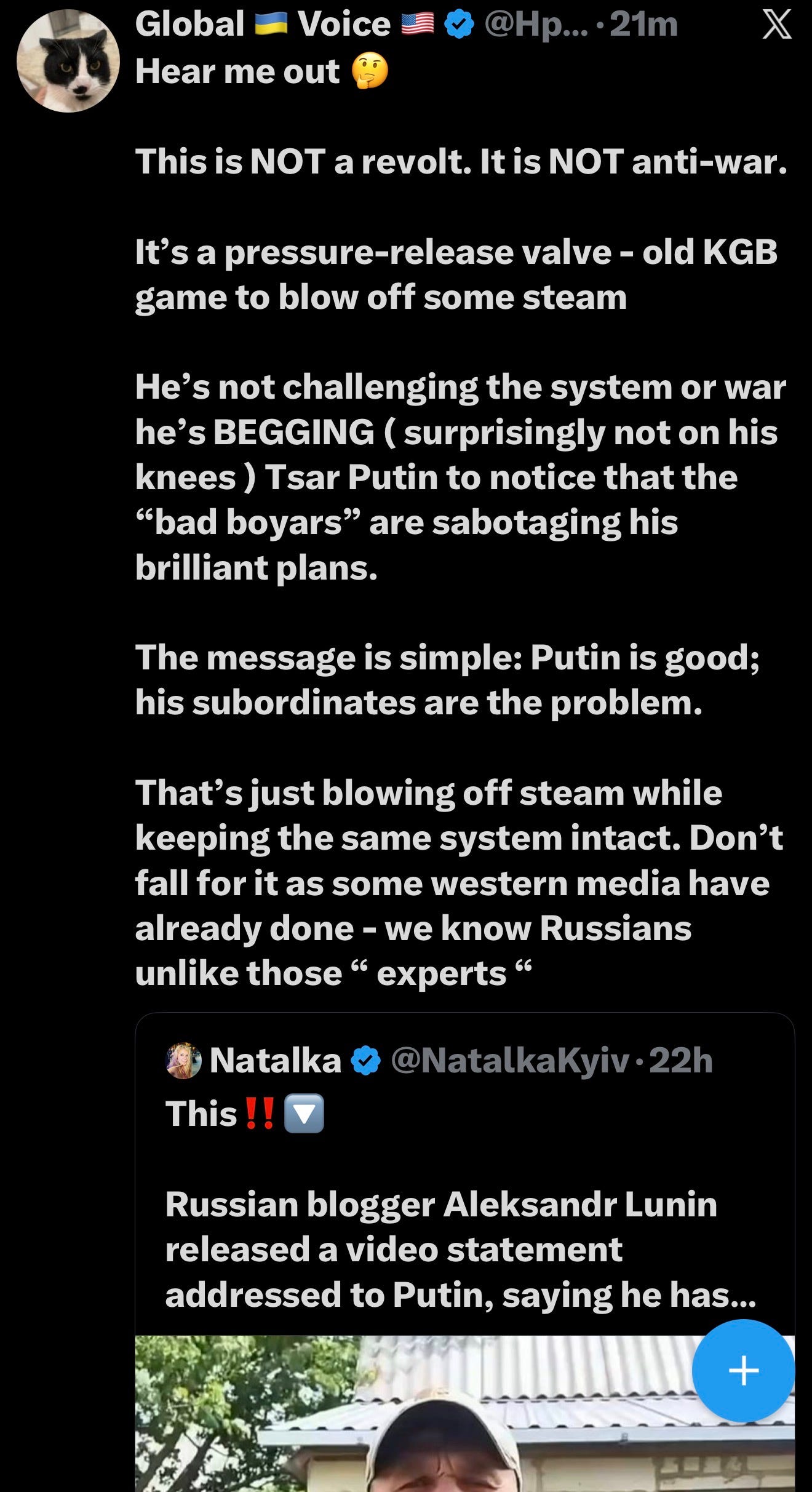
Here is another astute analysis of the video’s likely meaning. An archetypal analysis indeed:

I detected the existence of Russia’s use of archetypes in Disinfolklore back in 2015, in Russia-occupied Ukraine — reading the flood of propaganda that washed across the line where I was working. The same characters kept walking through it: the Merciful Sovereign who would protect you if only you submitted, the Bridge Troll who guarded the crossing, the Outer-Realm Monster massing on the horizon. I started cataloguing them. Ten years on, I recognise one of those characters the moment it appears — and the Lunin video is one.
A walk-in is one of the most carefully built characters in Russia’s Disinfolklore apparatus. It has many faces — a soldier, a civilian, a doctor, a defector, the former spokesperson for a president who turns up in an interview with a sympathetic foreign host — but a single structure. Others call it the whistleblower. I call it the walk-in, because the name tells you what it does.
The walk-in is the oldest device in storytelling. It is the stranger who arrives from outside with an urgent message that changes the plot — the ragged pilgrim at the gate, the messenger wolf, the old woman who knocks at the door asking for bread. In every folklore on earth, the walk-in is how a teller hands the audience a piece of news they could not have discovered for themselves. We trust it precisely because it arrived unbidden, from beyond the frame.
Russia has industrialised that trust. Bloomberg’s Stephanie Baker has documented the factory: an operation she traces under the name Storm-1516, which manufactures these arrivals at scale — paid actors, staged testimony, forged documents — and then has them amplified by Western influencers until they feel like something the internet found on its own. The whole point of a walk-in is that nobody seems to have sent it. Storm-1516 is the machine for making sure of that.
Now look at Alexander Lunin. This week a video of a Russian soldier by that name threatening Putin with a mutiny was watched eleven million times in a day. His video walked into our timeline exactly as a walk-in should — the unbidden insider, the man with terrible knowledge, the urgent message that the army may turn its weapons on the Kremlin.
And here the device folds in on itself, which is the tell. Inside the video, Lunin narrates a second walk-in. He says officials from the Defense Ministry and the security services called him into their car and decided to use him to carry a message to the president. A walk-in inside a walk-in: the staged messenger arrives on our feed, and within it the apparatus’s own hand walks openly into the frame and is offered as the proof. We are being shown the strings and told they are the puppet moving freely.
And look at what the messenger actually says (I’m indebted to @HpyNtlya on X for this astute analysis) because the content gives the game away as surely as the form.
This is not, as @HpyNtlya notes, a revolt, and it is not anti-war. Lunin does not challenge Putin, or the war; he begs the Tsar to notice that the bad boyars — the corrupt commanders, the cruel ministry — are sabotaging his brilliant plans.
The message is the oldest one in Russian political life: the Tsar is good; his servants are the problem. Naïve monarchism — the Good Tsar and the Bad Boyars — a pressure-release valve, the old game of letting people blow off steam while the system stays exactly intact. A real mutiny points its weapons at the throne. This one points them at the throne’s enemies, on the throne’s behalf.
The supporting details all point one way. He was not born Lunin. He was born Pustovalov, and in 2023 he walked into the name Lunin. He fought in the Sudoplatov battalion — named for a Soviet assassin — formed by the occupation authorities of captured Melitopol. The man is a product of the apparatus from the start.
Which brings me to the name, and to the part that is hardest to prove and easiest to feel. Lunin comes from Luna, the Moon. And Russia’s security services reach for the Moon again and again, because the Moon is where our oldest words for the mind begin. The reconstructed name for the Moon — méh₁nōt, “the measurer” — is the root of monarch and mandate, mind and meaning, numen and immanent. For six thousand years the Moon has been our master metaphor for the medium that carries meaning. To feel foundational — to sit underneath everything — the apparatus reaches for it.
So Dugin, the Kremlin’s security services actor “philosopher,” declares Cheburashka — a gentle children’s puppet — “a demon of the moon.” So the Kremlin publishes a decree to put a nuclear power plant on the Moon by 2036. And so a manufactured soldier walks into our feed wearing a moon-name. Three scales of one reach, for the foundation-stone of thought.
I cannot prove the casting call. But everything about this video — the unbidden arrival, the insider with terrible knowledge, the apparatus narrated openly into its own story, the man renamed for the Moon — is the shape of a thing I have been reading since 2015. When a character this carefully built walks into the room, name it. And watch for the next one.

Thank you
It may or may not be staged but it does fit the "good tsar, bad subordinates" trope that is a well documented feature of Russian political culture going back centuries.
The "KGB pressure-release valve" interpretation is plausible but speculative. The more likely explanation, I believe, is simply a distressed veteran doing exactly what the "bad boyars" tradition predicts ordinary Russians do organically: blame the system's failures on corrupt intermediaries while keeping faith with the leader.