



Jeffrey Sachs was in my mind because he was this kind of devil from the early 1990s, when he was responsible for shock therapy or whatever. But I hadn’t encountered him in reference to Ukraine until I was on holiday on the Turkish Riviera in the summer of 2024. A really close friend of mine — who, like many people, has no sympathy for Ukraine and loads of sympathy for the plight of Palestinians — and I said to him: “Look, you’re really lucky, because I’m one of the few people who has spoken to more local elected officials in Ukraine than almost any Westerner.” I spent four years of my life, every working day, going into the villages and the hromadas — the decentralised former Soviets — and speaking to people. That was my level as a very low-level diplomat and member of the international community. I discovered I could get meetings with these village heads who had been elected under this amazing decentralisation plan which Ukraine introduced on the 1st of April 2014. President Poroshenko did amazing work with it, and so did President Zelensky.
Power was decentralised to these villages, former Soviets which had never had any power. They used to have to go to the district councils to get money to change a light bulb. All the elections were fixed. All these communities were designed around the communal farm. Until relatively recently, many of the people there didn’t have a passport — they couldn’t even leave their villages without permission. Suddenly this new process comes in, and you have these amazing leaders, male and female, in Dnipropetrovsk, Zaporizhzhia and Kirovohrad — that was my area of operation. In Dnipropetrovsk, half of the hromada leaders were women. I went to each of them and asked: what made you do this? It was a voluntary process. They would bring me around these amazing schools — European-standard schools funded by the European Union, the Ukrainian government and USAID.
It’s an amazing story of decentralisation of power, of governance reform, which is virtually impossible in most of our countries because there are so many vested interests. Ireland, for instance, still has the same governance structure it had when it was ruled by England. It’s just impossible to change. So it really impressed me that in Ukraine, in the midst of a war, over the course of five years, they rammed through this really democratic process. This is probably why the left — and there are many people in the English left who full-throatedly support Ukraine and have been over there a lot — anyone who looks into Ukrainian governance will be really impressed by what they do. They keep 50% of their taxes.
I’m saying to my friend: “This is my experience. I can tell you there are no Nazis in Ukraine. I can tell you they will fight to the last person. I can tell you these are the areas that are now occupied, and I met the leaders there. Some of them are dead now. Some of them are in jail. Others are just waiting, biding their time to come back. I think every day of the people I met in schools there, the older people who gave us gifts and bread, who are in these places the Russians have been brutally occupying.”
And then he quotes Jeffrey Sachs to me. I said: “Who is Jeffrey Sachs? I don’t even know if he’s been to Ukraine. And somehow you believe him over me — your friend whom you’ve known for decades.” That has always stuck in my mind. Whenever I hear Jeffrey Sachs, I think about it. I think about what kind of algorithm is serving this stuff up to my friend — that he’s watching Jeffrey Sachs talking about things — and why is he believing Jeffrey Sachs over me, someone who has actually been there and talked to the people?
I used to think, when I set out on this path in 2018 to try and understand Donald’s magic — how did he troll people so successfully? — that it was just a matter of getting the truth in there. I wrote my first things online in 2019. Up to that point, I was completely invisible. But now I realise it’s about amplification. It’s about bot networks. It’s about the financial motivations of these people. But in a way, it isn’t even about financial motivation — all of us spend most of every day on Ukraine, and none of us are earning any money from it. So it’s about amplification and bot networks. And someone like Sachs — he lost his soul a long time ago. Like Donald, he has no shame.
The shame of being called out won’t make him skulk away, because he’s not in good faith. He’s not right. He’s not looking at the Code of Positive Trolls. He knows what he’s saying is a lie. He knows how much money he’s got from China, from the UAE or wherever else to do this. It’s part of this whole system. I think I saw he’s got seven bookings in twelve days. Who’s doing that? No one’s doing that for you, Wendy, or for me. There’s a whole network — a paid, financial network behind it, of Russians, of the oligarchs he helped enrich — whatever his motivation. I guess we’ll still see him popping up again and again. It’s always a bit annoying when people like Will Thiel and people like me, who know a lot more in a provincial, regional way about governance in Ukraine — why is no one platforming us? We just have to keep on trucking.
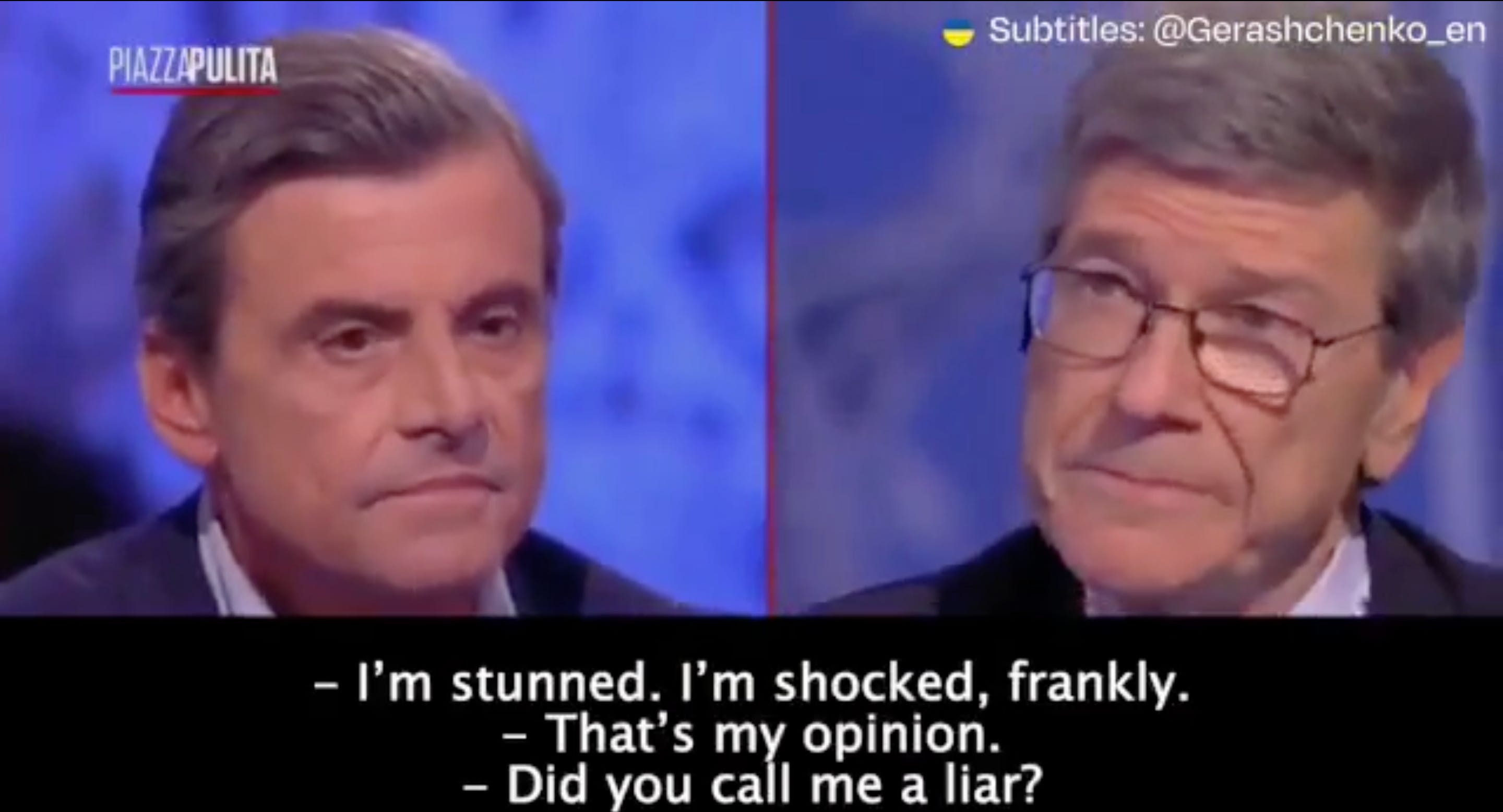
It was great to see him exposed in that way, and I’m glad to see it. But I guess he’ll keep selling his wares. We see these people — like Putin, like the war itself — as a complete disaster repeating again and again. He’ll probably continue doing that.
I’m always usually quite happy when I try — as gently, as astutely, as skilfully and as unemotionally as I can manage — to challenge people. I often think about this conversation I had in Turkey about Jeffrey Sachs. I’m glad I had it. I don’t know if I changed my friend’s mind, but I hope so. We need to challenge these things and find skilful ways — emotionally resonant ways, clever ways, different voices — not to go on about it, but to find skilful means to convince people. Definitely call out the lies. When we have knowledge that the person is lying, call it out. But the real lesson is that presenters aren’t doing it, and we see this in America a lot at the moment, which is terrible.
Volume and frequency — that’s one of the key patterns. Take the Jeffrey Sachs thing. He’s not on my mind at all. When I look at YouTube, I clean all my cookies so I just get the default feed. But clearly my friend has probably got six years of vatnik stuff brainwashing him in his algorithm. With Jeffrey Sachs, I remember scanning my timeline and you suddenly see this thing in a positive sense — and you know that’s going to be the issue of the day. So you try to come up with a response.
We see these repetitive patterns, which many of us are tuned into — particularly coming from Russia, because they just come up with the same lines again. It’s on a calendar, like an Outlook calendar. “Six months now, we have to go for peace negotiations again.” “Let’s accuse Zelensky of buying a castle in God knows where — should we say Italy or America this time?” The repetition, volume, frequency — then you see the same energy outward. It’ll always be Zelensky buying something. The energy is “corruption.” But it won’t always be a castle in Italy. Sometimes it’s California. I think he was buying a ranch today. Of course, that repetition also works — it convinces people it’s true. But for us who are deliberately trying to look out for it and not fall for trolls, when I see something repeated like that, I’m suspicious. It gets me to look closer.
We no longer have to rely on some quaint Italian TV programme. We are making the news ourselves, trying to make it as engaging as possible by sharing interesting things, creating interesting things with different voices, different colours, humour. That’s a very positive thing which never existed before. We are fighting back. What Volya Radio does with Mokrushyna, with Will and all of you — Genesis Man, Midwest Fellow, yourself Wendy, Iona of course, Yeni, and everyone — is countering this in our own way. We’re creating spaces that never existed before, when we used to have to rely on people like Jeffrey Sachs or the talking head on the weekly current-affairs show in whichever village or country or town we lived in. That is quite wonderful. It’s also part of the problem, but at least we have a voice and we’re not just shouting at the TV.
The things I’ve spoken about before are character. You see character in memes, in tropes — not just individuals but these tropes coming up again and again. The Victoria Nuland one and all of that. Part of the really annoying thing — when people like my friend start talking about this conspiracy, when you know the truth — is that Sikorski, who is now obviously a hero and has learned from the experience, had negotiated with Klitschko. He and Klitschko had persuaded the demonstrators to stand down and allow Yanukovych to continue. It was only that Yanukovych did a runner that the deal fell apart. The idea that the Americans and the American establishment wanted the demonstrators to take over — it just betrays a worrying lack of understanding of the character immanent in our governance structures and our leadership and our leaders. The last thing they wanted was a revolution.
This idea of Victoria Nuland passing out these really cheap biscuits — anyone who’s been to Ukraine will know Yulia Tymoshenko’s supermarket chain. You buy the biscuits by the weight. That’s what Nuland was giving out. Anyone repeating this conspiracy betrays a worrying lack of understanding of the character of people in our political establishment. They did not want this to be happening. They’ve done everything they can since the time General Electric built the Zaporizhzhia Dam in the 1930s as part of Stalin’s five-year plan. They’ve done everything they can to give Russia respect and keep it alive. The idea that they would have done this coup thing is absurd.
Of course, the people accusing the CIA and Victoria Nuland of doing what they in their conventional world would never have done are the very ones who were creating the coup — by hiring Paul Manafort, a Republican strategist who is now advising Donald. We may see Donald pursuing a coup in Ukraine again — every now and again he talks about President Zelensky’s legitimacy. Onwards.
Frequency and repetition — we see these same things coming up again and again. On one level it’s maddening, on another it’s hilarious, on another it’s just really worrying that people who supposedly know something about geopolitics think the world works that way. They’ve just read too many of that guy from MIT’s stories about CIA coups, and not enough of Michael Weiss’s stuff on the GRU and Russian intelligence. They have a completely wrong understanding of the character of our very conservative governance structures. And it’s a bit annoying.


