


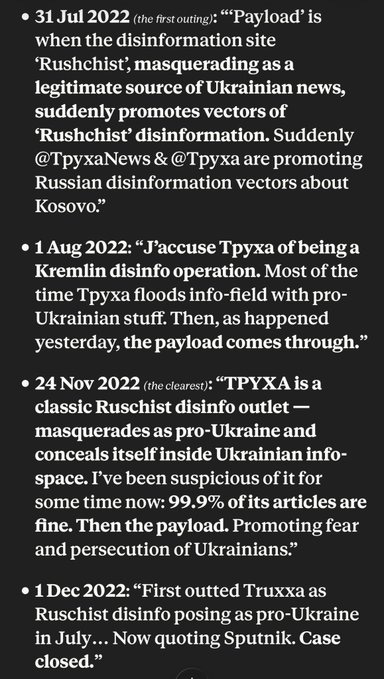
Four years ago I was scrolling a Ukrainian Telegram channel called Trukha. It is the biggest news channel in Ukraine. Over three million subscribers read it. It carries air-raid alerts, front-line clips, football, discount codes, the lot. And there, in among the news, I kept seeing a phrase: Kosovo i Metohija.

Kosovo i Metohija is not a neutral name. It is the Serbian state’s irredentist name for Kosovo, the name that says the territory can never be anything but Serbian. I know this because as a diplomat in the OSCE I often encountered the meme “Kosovo i Metohija” in the minutes of meetings. Often these minutes never revealed which country said what. However, whenever I saw the phrase “Kosovo i Metohija” I knew the speaker was speaking on behalf of Russia or Serbia - no other member state of the OSCE ever used that meme. Moscow loves that name. It is the frame Moscow borrows whenever it wants to say that borders are negotiable and that some nations do not really exist. And here it was, dressed as news, in the most-read channel of a country fighting for its own borders. I am not Ukrainian. I read the channel through a translator app. Even so, the meme stood out like a wrong note. That was my first sighting of what I have come to call a Trukha problem. Not a problem with one channel. A problem with a form.
This week the form became news itself.
What happened this week
Ukraine reshuffled its government, and its defence minister, Mykhailo Fedorov, left the post. Fedorov then said something remarkable in public: that from the moment Trukha was bought by a new owner, the channel began working systematically against him, and he named the parliamentarian Danylo Hetmantsev as connected to the campaign (Detector Media, 16 July 2026: https://detector.media/infospace/article/251248/, and DSnews: https://www.dsnews.ua/ukr/politics/fedorov-zvinuvativ-naybilshiy-telegram-kanal-ukrajini-u-zamovniy-kampaniji-proti-nogo-16072026-463553).
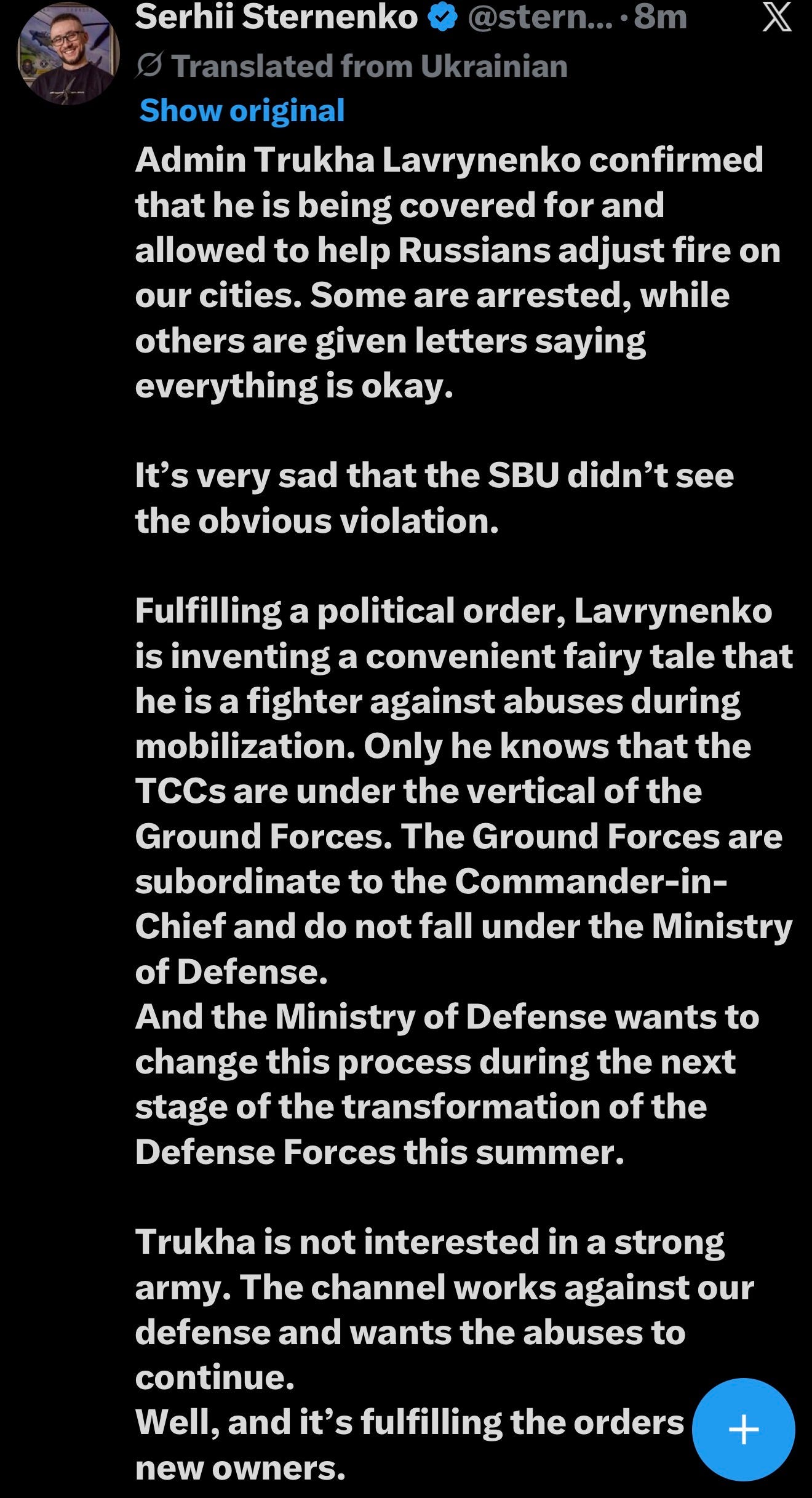
The activist Serhii Sternenko had already published an investigation pointing to a Kharkiv crypto entrepreneur as the likely buyer, possibly holding a Russian passport. The channel’s previous owner was mobilised in June and blamed the minister personally.
Claims like these are easy to make and easy to dismiss. Everyone in a political fight says the media is against them. So I did what the Disinfolklore method always asks: I measured.
What the data shows
Trukha’s flagship channel publishes its full history on the open web. I collected 35,135 posts, everything the channel published from 24 March 2024 to 17 July 2026, and counted every mention of Fedorov by name. There are 126 of them across twenty-eight months.
For two years the channel liked him. As digital transformation minister he appears as a steady good-news figure: online marriages in the Diia app, cashback for buying Ukrainian, 5G tests. When he became defence minister in January 2026 the channel amplified his own framing, often verbatim: his plan for the war, his Ramstein results, Elon Musk replying that he was “glad to help” against Russian drones on Starlink. On 22 January the channel even reported, straight, that Sternenko had become his adviser on front-line drones. In twenty-six months of coverage there is no sustained hostile frame anywhere.
Through May he is almost invisible, and when he appears, the channel praises him. On 18 May it credits him with Ukraine’s first domestically produced guided bomb (”per Fedorov, development took 17 months,” post 137723). On 28 May it reports neutrally on infantry pay talks. Two mentions in five weeks. Both friendly.
Then comes the evening of 5 June, at 20:01. The channel posts this, in its own editorial voice (post 138911, https://t.me/truexanewsua/138911):
“And tomorrow we will tell you about the corruption in drone procurement organised by pan Fedorov. Yes, that one. Don’t switch.”
News channels do not talk like this about their news. Campaigns talk like this. It is a trailer. Someone had decided, before the facts were shown to the audience, that the minister was now a target, and was building appetite for the reveal.
From that post forward, the channel mentions Fedorov twenty times in six weeks. Eighteen of the twenty carry a hostile frame against him, or defend the channel against the people investigating it. The only two exceptions simply report President Zelensky’s own words after the dismissal. On 13 June the channel platforms Hetmantsev, the very man Fedorov later named: “We thought Fedorov spent five months preparing a reform, but he spent five months preparing a website.” The full post list, with identifiers and timestamps, sits in our project archive and any reader with a browser can verify every one against the channel’s public record.
The most important move in the data is subtler than volume, and this is where the method earns its keep.
The mechanism: real stories, redirected Mana
Ukraine has a real and painful public issue with its territorial recruitment centres, the TCC. Cases of brutality are documented by the country’s own human rights ombudsman. Trukha covered such stories before June, as most Ukrainian channels do.
What changed on 5 June is not the stories. It is the name pinned to them. A man dies in a Zakarpattia recruitment centre: the channel asks when Fedorov will do his job. A detainee in Mykolaiv is found with broken ribs: “When will Mykhailo Fedorov perform his duties?” A dog in Odesa is thrown from a recruitment bus with broken legs: “Is this the plan of Fedorov’s ‘genius’ reform?” A TCC officer chokes a woman in Lviv: “this is our reform from Fedorov’s Ministry of Defence.”
In my framework this is Tool 3, Mana in the Meme. Mana is the energy and intention a meme carries into your mind. An atrocity story arrives carrying genuine moral energy: grief, disgust, the demand that someone answer for cruelty. That energy is real and it is right. The manipulation is in the plumbing. The channel builds a channel-bed for that energy and points it at one man’s name, every time, so that three million readers’ legitimate anger at a systemic problem arrives, drop by drop, as a verdict on one minister. The stories are true. The redirection is the payload. This is why sophisticated readers get caught. Checking facts does not protect you here, because the facts check out. You have to check the Mana: where is this energy being sent, and who dug the trench?
And notice the trailer’s other tell. “Don’t switch.” Urgency is Tool 8’s red flag. A channel that has evidence of corruption publishes evidence of corruption. A channel that has a campaign publishes a countdown.
A channel that sounds like truth
There is one more layer, and it sits in the name itself.
To an English ear, Trukha sounds like truth. In Ukrainian the word труха means something close to the opposite. It is the dust of rotted hay. Chaff. What is left when the goodness has crumbled out of the stalk.
In my framework, the final judgment on any meme, or any channel, is to proof it against the Code of Positive Trolls. The verdict comes out Positive, Negative or Neutral. The central test is Tool 7, Right: is it TRUE?

And here is what this case teaches about that question. Sentence by sentence, Trukha passes. The guided bomb was real. The pay talks were real. The recruitment-centre cruelty was real and documented. A fact-checker would clear post after post. Yet the channel fails the proofing, because truth is a property of the telling, not only of the sentences. A telling that selects true facts and lays every one of them toward the same target is not telling the truth. It is telling the target.
That is what the Code catches and a fact-check cannot. The proofing does not ask “are the sentences accurate?” It asks whether the Mana is right. Is the meaning generous? Is it patient, or is it a countdown? Does it deepen your understanding of a systemic problem, or flatten it into one man’s face? Ask those questions of the twenty posts and the verdict is not close.
So the name adjudicates itself. Heard from outside, truth. Read from inside, chaff. A channel can be both at once, and that is precisely the form’s power: the truth is in the sentences, and the chaff is in where they are all blowing.
What we found before
This is not our first look at Trukha. Earlier this summer we assembled a corpus of 108,051 posts from four of the network’s regional channels, covering 2021 to 2024, and ran a systematic hunt for conduit channels: outlets inside the network’s orbit that relay despair, defeatism and anti-mobilisation themes into Ukrainian readers’ feeds while wearing the clothes of local news. That work flagged a set of candidate conduits, and it corroborated what Sternenko’s team had been arguing from their own direction. The Kosovo i Metohija memes I spotted four years ago were an early, visible symptom of the same underlying condition: a trusted high-volume channel whose relay choices, post by post, lean somewhere its readers have not consented to go.
So when the ownership changed and the tone flipped, we were not starting from zero. We had a baseline, and the flip stood out against it exactly the way a break should.
What I am not saying
Here I want to be plain. Ukraine’s government is Ukraine’s to choose. Whether Fedorov should or should not be defence minister is a question for Ukrainians, their parliament and their president, and for no one else. I support Ukraine. That support gives me no vote and no standing, and a foreigner who uses “support” as a licence to lean on Kyiv’s internal choices has misunderstood what support means. I contend nothing about the reshuffle itself.
I am also not saying the TCC stories are false, or that criticism of a defence ministry in wartime is illegitimate. A free country criticises its ministers. That freedom is part of what Ukraine is defending.
What I am saying is narrower and, I think, more useful. The data shows a dated, measurable break in one channel’s behaviour toward one man, beginning with a self-announced campaign trailer on 5 June 2026, immediately after a change of ownership that the channel will not explain, in a channel already carrying a documented history of relay choices that serve Moscow’s frames. Ukrainians noticed it themselves. Fedorov has called for journalists to investigate. The channel’s police complaint went nowhere. The measurement simply confirms what the pattern-literate eye suspected, and puts a date and a number on it.
Every galaxy has one
Here is why this matters far beyond one Ukrainian scandal.
In my work I describe disinfolklore galaxies: the connected clusters of channels, outlets and accounts that share, relay and amplify each other’s memes across an information space. Every galaxy has a Trukha. Ours too. Somewhere in your feed, whatever your country, there is a high-volume, trusted, useful channel that earned its place honestly: alerts, sport, local news, the daily texture of life. That accumulated trust is an asset. Assets get bought. And when they are bought, nothing on the surface changes. The alerts keep coming. The football keeps coming. What changes is the plumbing underneath: whose name gets pinned to which anger, which real grievances get a trench dug toward which target.
You cannot detect that by fact-checking, because the facts are mostly true. You detect it the way we detected it here. You get your eye in for the wrong note, the way Kosovo i Metohija reads wrong in a Ukrainian channel. You watch for the trailer voice, the “don’t switch,” the manufactured countdown. You ask of each emotive story not “is it true?” but “where is my reaction being sent?” And when you can, you count. A valence flip with a date on it is worth a thousand suspicions.
Trukha’s three million readers are not fools. They are among the most propaganda-hardened publics on earth, and the channel caught a good number of them anyway, for a while. That is the measure of the form’s power, and the reason to learn its shape now, in the one information space where it has just been caught in the act.
The trench is dug before the water arrives. Learn to see the trench.
Stephen Douglas is a writer who publishes on Disinfolklore.eu, Disinfolklore.net, PowerofMana.net, and as Decoding Trolls on Substack and X.


