




As in all my work, I’m both working through these contemporaneous examples of writing and Ruschist Disinfolklore in order to apply and fine-tune the method, but I’m also hoping to then communicate some of the power of the method, which is the twelve-tool way, available at disinfolklore.eu.
Midnight Tea at the Kremlin
So the clock on the Kremlin tower had already struck midnight on the 28th of May 2025 when Andrey Melnichenko was finally summoned. Vladimir Putin greeted his guest, invited him to sit beside him, and offered him tea. Move closer, Andrey, Putler said kindly. A red folder lay in front of the president. Melnichenko guessed it was his own security service dossier. Is someone bothering you? Putler asked, with care.

Melnichenko told the president that the mistake of Russia’s business elite had been to separate their fate from the fate of Russia. He thanked the Russian dictator for helping him see the light. Putler was pleased. For years he had warned the oligarchs that they were not truly welcome in the West. Now one of the foremost among them had admitted that Putler was right. The audience lasted over an hour.
The scene is not mine. It is the opening scene of The Economist’s own profile of Melnichenko, published on the 9th of July 2026 in 1843, the paper’s long-read magazine, named for the year of its founding. The headline: a top Russian oligarch breaks the silence.
Why 1843 Matters in My Oeuvre
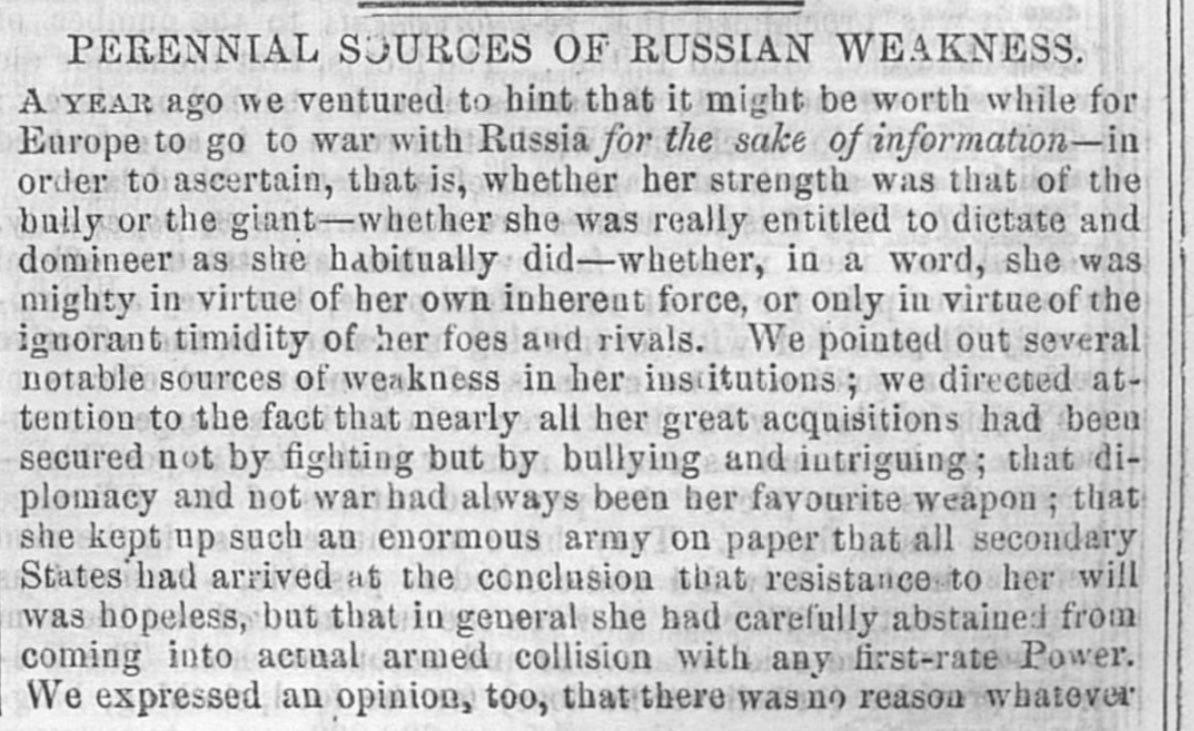
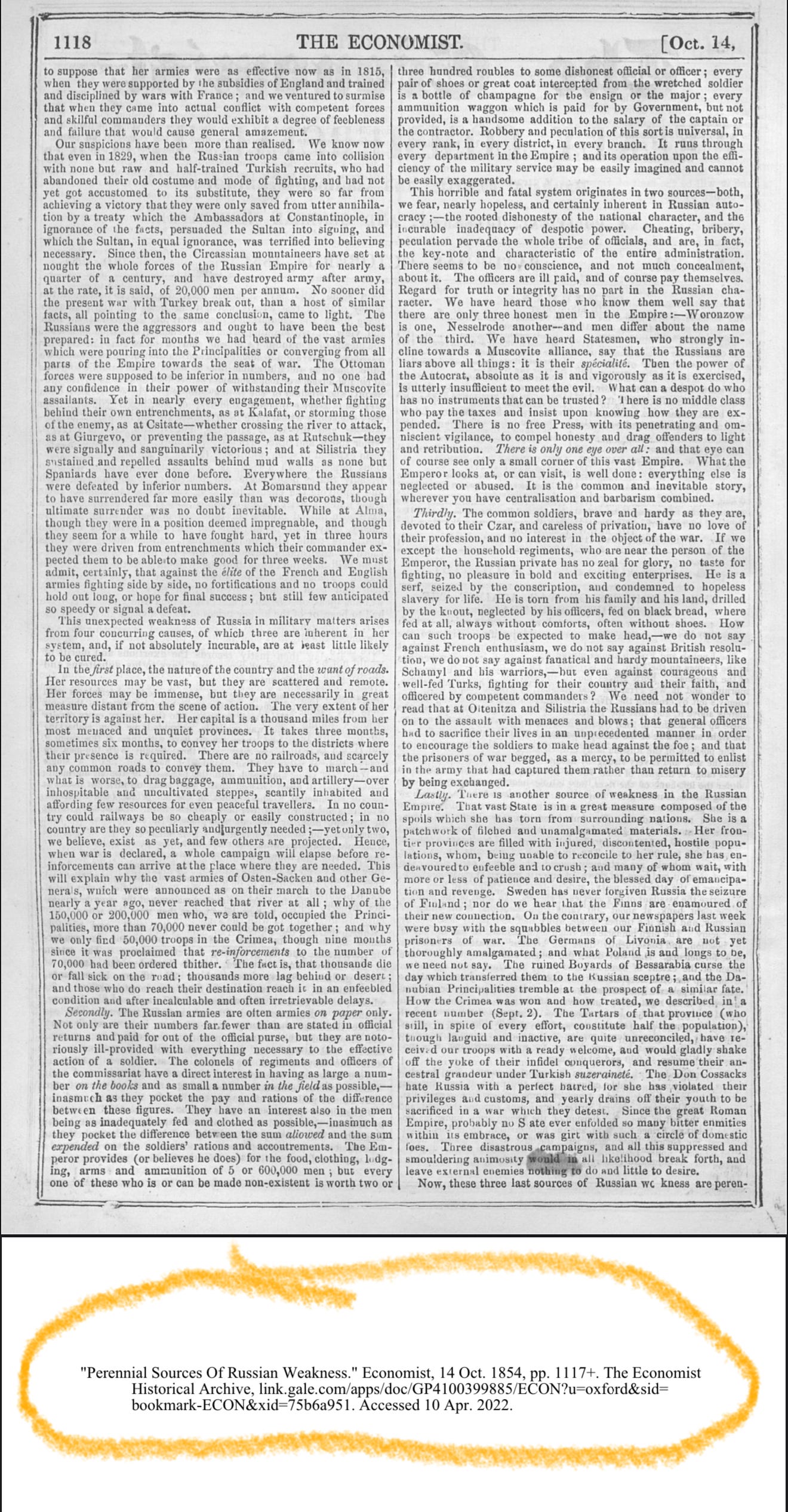
Some of you who have been following my work since the beginning of the full-scale invasion might recognise the significance of 1843 in my oeuvre. One of my first posts on Twitter regarding Russia was on the 4th of March 2022, when I was still employed as a diplomat for the Organization for Security and Co-operation in Europe. And I had, several years before, gone through all the documents I could find relating to the first Crimean War, to try to understand if it would give any insights into the current, the second Crimean War. And I found this amazing Economist article, which I then wrote about, in which it describes the perennial problems of the Russian army. And you won’t be surprised to know they are exactly the same problems that we see today.

Not only that, but even by the 4th of March 2022, it was clear, in the space of less than a week, that the perennial problems of the Russian army were still the ones that had afflicted it in 1853 — sorry, I’m muddling my dates; it was 1853 — and that afflict it today. So much so that the Washington Post saw my post, and Max Boot did an editorial based on it, basically saying the Russian army hasn’t changed at all since the first Crimean War.
So, to see this puff piece for a Ruschist. So: a man takes tea with the Tsar at midnight. He recants his Western life to the Tsar’s face. He is shown the folder that owns him. Ten months later, he breaks the silence in the West’s most trusted liberal weekly, while living in Moscow, unarrested, his factories defended by the Russian army. The silence was not broken. It was commissioned.
One Package, Two Vessels
The Economist didn’t publish one piece that week. It published two. The profile — 37 minutes of reading, built on 60 hours of granted conversation — tells us who the man is. And beside it, under the paper’s By Invitation rubric, the man’s own manifesto: why a broken Russia is bad for the world. The paper’s standfirst, the line under the headline that tells you what to think before you read, asserts his conclusion as if it were the weather: when the war in Ukraine ends, Moscow will need to be part of the new security architecture.
The two vessels carry one payload. The profile manufactures the character — the physicist, the outsider, the chaos theorist, the man who avoids ideological and moral judgments. The manifesto then delivers the policy: stop pressuring Russia, accept its sovereignty over everyone, and let its elites design what comes next. Character first, payload second. This is how you serve a troll to readers who think themselves too clever to be trolled.
I spent years inside Russia-occupied Ukraine from February 2015, watching how this machinery works on ordinary minds. I called what I found Disinfolklore: the narrative form in which meanness is communicated directly into people’s minds, working on their intentions, their attitudes and their moods, without their even knowing. The Melnichenko package is Disinfolklore of the highest grade. It is also 200 years old. That’s the point of this mission: the same families of Chekists and KGB men have been in charge of Russia for 200 years. Same genes, same memes — communism, empire, Russkiy Mir. Old wine, new bottles.
The Manifesto: A War With No Actors
The payload sits in the manifesto, so the manifesto comes first. It runs to some two and a half thousand words about the war in Ukraine. The word invasion appears nowhere in it. The name Putler appears nowhere in it. Bucha, nowhere. Mariupol, nowhere. The tens of thousands of Ukrainian children Russia has abducted appear nowhere. A Russian industrialist writes two and a half thousand words about this war for a Western audience, and the man who ordered it, and the people it is murdering, never come up.
Instead, the war has weather for causes. Great wars do not begin when the first shots are fired, the essay opens portentously. The front line is merely the point where accumulated pressure breaks through to the surface. Pressure accumulates. Bonds break. Politics does not direct events; it is led by them. Nobody decided anything. Nobody loaded the missile that hit the Okhmatdyt children’s hospital in Kyiv. Physics did it.
When the essay finally gives the war a verb, the verb has been chosen with jeweller’s care. In 2014, after what it calls the political upheaval in Ukraine — meaning the revolution in which Ukrainians died for the European future their president had stolen from them — Russia concluded that democracy had run its course, and then acted: first in Crimea, then, eight years later, across four eastern and southern Ukrainian regions. Acted. The largest invasion of a European country since 1945, the flattened cities, the eviscerated humans, the torture basements of Kherson and Izium, the filtration camps. Acted.
Then the single most revealing word in the whole document. The West’s support for Ukraine, the essay complains, is really a war on Russia in which, geographically, the fighting stays on Ukrainian soil. Formally, Ukrainians do the fighting. Formally? Twelve letters that erase a nation. Ukrainians are not, in this man’s account, defending their children from a neighbour who has come to murder them. They are a formality through which the West conducts its pressure. And when the essay concedes in one sentence that Ukrainian sovereignty is real, the next sentence takes it back: Ukraine’s security, built on the permanent negation of Russia’s sovereign agency, is equally unstable. In this grammar, Ukraine defending itself is an act of aggression against Ukraine.
The Menu of Four Futures
The essay’s core is a menu for genocide. It’s a menu of four futures for Russia, and the menu is the message. Future one: a Russia brought in from the cold but treated as a defeated power. That, we are told, breeds aggressive revanchism. And here comes the century-old chestnut, produced on schedule: Versailles was not the creation of order, but the accumulation of deferred energy. Mana, you might say. Punish us and you manufacture the next Hitler. Future two: Russia as China’s vassal. Future three: Russia fragments, and a fragmented country with a nuclear arsenal is America’s worst nightmare. Future four: Russia as a fortress — North Korea.

The Economist’s profile adds a detail the manifesto omits: this fourth scenario is promoted by the security services and subject to serious discussion in the Kremlin. That admission tells us the author knows the security services’ internal menu. The paper does not ask how he knows it.
Then the punchline. The forms are different; the systemic result is the same. Every path except one leads to catastrophe for us. The one safe path is his: lift the pressure, accept sovereign rights, let its elites — its oligarchy, in the classical sense of the word — design the future, and ask no questions from outside. Because how Russia conducts its own political process can be resolved only inside Russia itself. No tribunal, no reparations, no returned children. This must be accepted.
There is a name for an argument whose every branch ends in your ruin unless you pay. It’s a protection racket. Nice civilisation you have there, mate. Shame if something happened to it.
The Nuclear Wrapper, and Moscow’s Three Demands
The nuclear payload is delivered in the same style, dressed as concern: pushed too hard, and nuclear weapons become the background radiation of constant risk. The profile carries the same threat in the same wrapper: he does not rule out the use of nuclear weapons; that is an outcome he is desperate to avoid. The mafia lawyer is always desperate to avoid the outcome he’s just described to you in detail.
And in the middle of the racket, printed by The Economist itself without a word of challenge, sit Moscow’s actual demands, presented as moderation because they have narrowed to three: recognition of the territories Russia now claims under its constitution; legal protections of Russian-speaking populations; and a formal commitment to Ukrainian neutrality. The first demand means the legal surrender of Crimea and four Ukrainian regions, including land Russia has never actually managed to occupy. The second re-arms the exact pretext on which the invasion was launched. The third disarms the victim. These are the maximal war aims of February 2022, relabelled as a compromise in the West’s most respected weekly.
The Factory: From the Third Section to Operation Trust
Nothing above is new. Russia’s opposition is a state product, with a two-century product line, and the security services are the factory. In 1826, after the Decembrist officers rose against him, Nicholas I founded the Third Section, the empire’s political police. Its successor, the Okhrana, learned the trade’s great secret: do not suppress the opposition — manufacture it. Own the vessel into which discontent flows, and you own the discontent.
Around 1901, the Okhrana officer Zubatov built exactly that: police-run trade unions, workers’ movements founded and steered by the secret police so that real workers’ anger would pour into state-controlled channels. The priest Gapon — Georgy Gapon — who led the 1905 march that ended in the Bloody Sunday massacre, ran an assembly founded under police patronage. Yevno Azef, the head of the Socialist Revolutionaries’ terrorist wing, was the most feared revolutionary in Russia. He was on the Okhrana’s payroll at a thousand roubles a month. Nice work if you can get it, mate.
The Bolsheviks inherited the factory and improved the product. From 1921 to 1926, the Cheka’s successors ran Operation Trust, a fake monarchist underground built by the secret police. Its genius was not just catching real oppositionists — it lured the revolutionary Savinkov and the British agent Sidney Reilly to their deaths. Its genius was its effect on us. The Trust persuaded Western governments and intelligence services that a serious opposition already existed inside the system: evolutionary, reasonable, about to mellow the regime from within. So the West waited. Waiting was the product. The Trust was a machine for manufacturing Western patience — which, I might remind you, is the third element of the Code of Positive Trolls: patience.
Every Generation Buys a Bottle
We’ve fêted Solzhenitsyn as the conscience of Russia and mostly declined to read his imperialism. In May 1982, the Washington Post ran the headline: Andropov seen as a closet liberal. The KGB chairman who crushed Hungary was sold to us as a jazz-loving, whisky-sipping moderniser — just as today Surkov is sold to us as a hip-hop-loving Ruschist. And the CIA’s own analysts filed a memo on his masterful public relations campaign, thus crowing about the very brainwashing that they themselves, the people writing these memos for the CIA, were undergoing.
In 1990 and 1991, as the Soviet Union cracked, the KGB built a licensed opposition party from scratch. By the account of Politburo member Alexander Yakovlev, KGB chairman Kryuchkov personally presented the puppet Liberal Democratic Party project — Zhirinovsky’s party — to Gorbachev.
Surkov, and the Oligarch’s Front Office
Surkov learned the trade in an oligarch’s front office. Mikhail Khodorkovsky, then on his way to being Russia’s richest man — temporarily — hired Surkov as security at his Menatep bank, saw that the brains outvalued the brawn, and put him in charge of PR. By the 2000s, Surkov was Putler’s chief political technologist, running the mature version of Zubatov’s factory: funding human rights groups with one hand, and the nationalists who attacked them with the other. The regime, in Pomerantsev’s summary of the Surkov method, climbs inside all ideologies and movements, exploiting and rendering them absurd.
And when we get to the third piece today, which is the fifth episode in Outflank Dugin, Don’t Rebut, we will see how I outflank even this analysis of Surkov as the power behind the throne — because I perceive him as an actor. So he’s a director, directing the rest of the opposition, but he himself is an actor, acting out the directorial role on behalf of the security services.
Reading the Profile With Our Eyes
And the oligarchs themselves: they were never the real opposition’s material. They were the factories. The first private fortunes of perestroika were, as The Economist’s own profile represents, created by the KGB’s economic directorate.
The profile, read with our eyes, says the quiet part about Melnichenko. His 1990s lottery crew — police cadets at the time — now occupy senior positions in the security services. His university cohort fed the KGB academy. His plants make the ammonia in Russia’s munitions. By the profile’s own reporting, and Bloomberg’s sourced reporting adds to the scale, nitric acid from EuroChem subsidiaries is sufficient for at least 6,500 artillery shells a day. He cooperates with the security services, it was said. The folder on the desk was not a threat to an outsider. It was a personnel file.
So when a manifesto arrives urging the West to wait — to wait for Russia’s internal evolution, to trust that the internal debate about what Russia should become is unavoidable, and that this conversation belongs after the war and inside the country — I contend we are reading a Trust document. The 1926 model asked the West to wait for the monarchists inside the system. The 2026 model asks us to wait for the industrialists inside the system. Same wine; the bottle has a fertiliser label now.
The Saviour Oligarch
There’s a reason the vessel is an oligarch this time, and not a poet or a chess player. In our work automating the detection of Disinfolklore, in the corpus I catalogued, a pattern I call the saviour oligarch appears again and again and again. The apparatus selects a very rich operator with a clean political skin — no discredited party behind him, no competing clan, deep quiet ties to the state — and installs him as the fairy-tale saviour who stands above politics. We’ve seen this attempted in Armenia. We’ve seen it succeed in Georgia, although it failed when the first fairy-tale saviour. We’ve seen it succeed in America, with Donald. We’ve seen it succeed temporarily in Moldova, and in almost every country where Russia operates.
The register the operators are trained into is always the same: pragmatic, institutional, professional, technocratic. Frame Russia as a reality. Never attack Russia. Leaked Kremlin planning documents published in 2026 spell that training out in so many words, for an operation aimed at one of Russia’s neighbours.
Yanukovych’s handlers ran the same play in Ukraine, where Donald’s man and still-adviser Paul Manafort took the disgraced Party of Regions — again, another Russian security services creation — and rebranded it. Same personnel, same ideology, as the Opposition Bloc, to try and vacuum up the entire space of the opposition, and moniker them Opposition Bloc. Russia does not just infiltrate oppositions; it names them. Surkov described Russia’s operation through such surrogates as its fig leaves, grown by hacking each country’s archetypes of national consciousness.
Khodorkovsky, the 2003 Edition
We’ve met the saviour oligarch before. Mikhail Khodorkovsky was the 2003 edition. His bank gave Surkov his start. His decade in the prison colony then minted him the most expensive persecution marks ever issued, and the West priced him accordingly. The robber baron walked out of the gate a conscience. Watch what the conscience does with the credential.
In the week after Navalny’s death, Russians who had actually taken up arms against Ruschism reported with disgust that Khodorkovsky was among the opposition leaders spreading the message that everything is lost, that nothing can be done, that we must just wait until Putler himself dies. Wait? The Trust product, from the man with the best suffering in the business.
My own exchanges with his channel run the same way. In December 2022 I suggested it might be easier for Mr Khodorkovsky to start using the vocabulary of Rashism. In August 2024 I sent the only correction that matters: focus on the Ukrainian teenagers your country is murdering every day. The question a saviour oligarch’s biography answers is never whether he suffered. It’s what the suffering is spent on. Khodorkovsky spends his own on waiting.
Melnichenko, the Deluxe Edition
And Melnichenko was never asked to suffer at all. His edition is the upgrade: the machine has learned it can skip the prison and go straight to the manifesto. Melnichenko is the pattern’s west-facing deluxe edition, and the selection criteria are all in The Economist’s own reporting. Rich beyond counting: businesses worth nearly 1 per cent of Russia’s economy — so, about two roubles, then. Clean skin: never one of the 1996 oligarchs, never in a party, not interested in politics, a man who watched the Berezovsky generation from the side. State ties: the midnight tea, the exempted fertiliser empire, the army defending his plants. Above politics: he does not think in terms of democracy and autocracy, good and evil. And the trained register, note for note: I am neither a politician nor an ideologist; I try to describe the world as a physicist. A physicist?
The manifesto attacks only Western decisions — sanctions, attrition, support Ukraine for as long as it takes. Not one Russian decision is criticised anywhere in it. That asymmetry is the fingerprint. Our so-called Russian oppositionists always aim at our leaders, at our institutions, at our will. The Kremlin’s targets and theirs are the same targets. I wrote that in February 2024, 29 months before the Melnichenko puff piece, and before this package shipped in The Economist. Such Russian oppositionists conceal their animus towards our democratic institutions by concern trolling.
The Credential Problem
Then there’s the credential problem. A saviour needs persecution marks, and this is where the two-century machine shows its newest refinement. I wrote the recipe down in February 2024. KGB 101: establishing the Russian oppositionist’s credential. Arrest, detain, persecute, poison the opposition Ruschist. Ruschism is my word for the fascism Russia has become, a cousin of the Ukrainians’ own Rashism. The West falls for the troll and is distracted from whichever genocide Russia happens to be executing. Navalny and Kara-Murza walked knowingly into the gulag to collect those marks.
Melnichenko’s marks are more comfortable: an EU sanctions listing he litigates in court, a seized sailing yacht, and one beautifully theatrical shakedown, reported by the profile with a straight face. In August 2023, prosecutors moved to confiscate a power plant he owned. Two weeks later they backed off, in exchange for a donation of 32 billion roubles, about $335 million — the exact sum he had paid for the plant. And the recipient of this extorted charity? Sirius, a school for gifted children personally favoured by Putler. The persecution pays tribute to the persecutor. The mark and the loyalty payment are the same transaction.
The Economist prints the byline the machine wanted: Andrey Melnichenko is a major Russian industrialist under Western sanctions. The sanctions are the credential — the persecution credential. This is where we’re at now, where wearing sanctions, justified sanctions, is the credential you need to lead Russia, according to the Western media.
There Was No Silence
And the headline verb is false on the record. There was no silence. Melnichenko called for peace through Reuters on the 14th of March 2022, in week three of the full-scale invasion: the war is a tragedy of the brotherly people — no invader named. He gave the Financial Times his sanctions grievances. He lobbied through Bloomberg. Four years, one message, and the message never once required him to blame the man who orders the missiles. The Economist did not record a man finding his voice. It amplified a man staying on it.
The Two-Part Test
How do we tell a real Russian opposition from a manufactured one? Not by exile, and not by arrests. For a century we’ve been used to the stock character, or type: Russian oppositionist. And the stock character is the product, not the person playing him. It’s very easy to become Russian opposition. The price of admission we Westerners charge is shamefully low.
A real test has two parts. A genuine Russian opposition figure advocates Russia’s complete withdrawal from every metre of Ukraine, Crimea included. And she helps Ukraine defeat Russia materially — not in the abstract, not after the war. Both parts together.
In my Automating Disinfolklore project, I ran that test systematically across the named field of Russian opposition figures and formations, with primary sources and an adversarial check on every candidate. The result should embarrass every Western editor. Two names passed. Sergej Sumlenny — Russian-born, who renounced his passport, exposed the RIA Novosti genocide manifesto of April 2022 for what it was, and raises money and delivers drones for named Ukrainian frontline brigades, with receipts, putting his own life at risk. And Ilya Ponomarev, the only one of 446 Duma members voting who opposed the purported annexation of Crimea in 2014, who paid with exile, and who became the political voice of Russians who took up arms on Ukraine’s side. Two, out of an entire imperial diaspora of talkers.
Even Garry Kasparov — no ally of Putin’s, and I believe he’s in good faith — fails the second part, and has a habit of attacking the same Western politicians the Kremlin attacks, and is against violently opposing Russia: against Ukraine’s expulsion of Ruschists from Ukraine by force. When Ukraine actually held Russian ground in Kursk oblast — the Russia-without-Putin that oppositionists love to talk about — a Ukrainian soldier there noted that not a single Russian oppositionist came even to talk to the locals. Though we know, of course, that Sergej Sumlenny was in Kursk. The opposition that will not show up at one liberated quarter of its own country is not an opposition. It’s a costume.
Scoring Melnichenko Against the Test
Score Melnichenko against the two-part test, and he does not merely fail — he inverts it. Withdrawal from Ukraine? His manifesto demands the opposite: legal recognition of the annexations. Helping Ukraine win? His factories feed the army Ukraine is fighting. He is not a fake opposition figure in the Navalny mould, words without action. He’s something purer: the oligarch paymaster with the middlemen removed. I wrote in April 2024 that all Russia’s opposition wants is sanctions relief for their oligarch paymasters. In 2026, the paymaster cut out the staff and wrote the sanctions relief essay himself.
And the good Russian? Good Russians know how to remain quiet for a time. Like Germans after 1945, they understood that penance through silence is what the moment asks of them. They do not stand on stages explaining Russia’s future while Russia’s rockets are in the air. What we get instead, from the whole sentimental class of civilised Russians who interpret Russia to Europe, is pleas for a Marshall Plan for the perpetrator. Melnichenko’s essay is that plea in a physicist’s coat — and the sentence that gives most away is its confession of what his class actually repents: we were once glad to absent ourselves. Not the shells. The absence. His sin, in his own accounting, is that he left Russia. To the men with the red folders, it is the only sin there is.
Why the Kremlin Needs The Economist
So why does the Kremlin need The Economist? Because propaganda in an enemy bottle is worth ten of RT Today. Nobody in Europe reads RT but its converts. And the paper that platformed General Zaluzhnyi’s essays, the paper that has genuinely championed Ukraine’s cause for four years — and, to give it its due, the paper that in 2025 helped bring the archaeogenetics of the Indo-European homeland in Ukraine to a broad readership’s awareness — that paper’s credibility is a delivery vehicle beyond the dreams of any troll farm. The more pro-Ukrainian the outlet, the more valuable its capture for a single payload. That is precisely why the package ran where it ran.
And this is not the paper’s first pour. In 1854, The Economist mused that invading Crimea might be justified — that defending Crimea, and invading Crimea, by the English, may be justified for the sake of civilisation. In December 2023, at the exact moment Western resolve wobbled, it called for a rethink of Ukraine strategy. And I called that what it was at the time: promoting Russian Disinfolklore. The 2026 package is the rethink, with a human face and a yacht. By February 2025 I had sharpened the charge to a question to The Economist, or of The Economist: what is the difference between The Economist and Meduza? There is none. Both exploit Ukrainian suffering and promote reformable Ruschism.
Sixty hours of access to Russia’s most enigmatic oligarch is not investigative journalism. It is granted access, and granted access is priced. The price is the frame. Kremlinology is an industry. The profile’s author, Arkady Ostrovsky, is the paper’s Russia editor, a Russian-born journalist — a real distinction — whose book, The Invention of Russia, won the Orwell Prize in 2016 for showing how the Kremlin manufactures reality. That book described how the Kremlin manufactures reality. Its author has now written a chapter of that reality. A Moscow-formed editor, fluent in the court, hungry for the scoop only the court can grant, is not a safeguard against the court’s product. He is its preferred customs channel.
The paper did print one sentence of antibodies: his proposals are self-serving, obviously. And one sentence is exactly what an inoculation is — a small dose of the objection, administered so the reader builds immunity to it before the payload lands.
The Package Did Not Travel Alone
On the 7th of June 2026, the Observer carried the exiled security services expert Soldatov: Putin’s Russia will not be defeated from outside; change must come from within. And I’ve read Soldatov’s book, and I think he’s in good faith. But sadly, he’s too far gone on being part of the Russian state to be in any way an objective critique. He cannot see, for instance, Russia’s occupation of Ossetia as an occupation. Even in his book about how the people around Putler — the liberal journalists — supposedly then went all pro-Ruschist, Soldatov himself reveals certain sympathies for, and blind spots for, Russia’s imperial adventures. And I’m sorry to say that, because, as I say, he may be in good faith. He seems like a nice chap just trying to sell books. But he’s in no way a proper interpreter of Russia, comparable to any one of 500 Ukrainian intellectuals who are silenced by our media.
The same day, Le Monde carried the exiled journalist Farida Rustamova: the regime is not on the verge of collapse, and any change will occur in a sudden and unexpected manner. Five weeks later, the Economist profile closes on the same proverb, borrowed from the reformer Gaidar: big changes in Russia happen later than we think, but earlier than we expect. And Melnichenko supplies the coda: trying to accelerate change is usually a mistake; all you can do is observe, and be ready for it.
Three prestige outlets, five weeks, one message: do not push, wait for Russia to change itself. When nominally independent voices converge on one frame — phrase by talking point, or by shared archetype, and it doesn’t matter which — that’s not analysis. That’s the apparatus, the Ruschist apparatus, speaking through ventriloquists to us. And I replied to the earlier pair at the time: you’re all on message. Free yourselves from mental slavery, I said to Soldatov — from the data-resistant archetypes of the Potemkin state. There, referring to this idea of Russia as internal, which I translate into a data-resistant archetype of a Potemkin state.
Prince Potemkin, whose body was literally, physically stolen by the Ruschists as they withdrew from Kherson. Prince Potemkin built fake villages along the Dnipro region to deceive his German princess, Catherine the so-called Great. His heirs build fake futures for every audience on earth.
Own the Floodgate and You Own the Flood
The profile ends by telling us the mechanism to our faces: there is certainly a yearning among the elite for someone to say what everyone already thinks; it might only take one man to break the silence for the floodgates to open. Quite so. Which is why the security state that has owned Russia for two centuries makes very sure it owns the one man. Own the floodgate and you own the flood. Zubatov would have signed that sentence.
Ukrainians read the package correctly within days. Ukrainian civil society leaders replied in The National Interest, under the title: why did The Economist platform a Russian oligarch? — noting that the essay contains nothing about Russia’s war of aggression or its crimes against civilians, and asking for equivalent space. The Kyiv Post called the scoop a polite version of the same Moscow threat, and observed that 60 hours of interviews given from Moscow implies Kremlin approval by itself. Listen to the people who’ve been reading this wine label for centuries.
What Does the Package Buy, and For Whom?
Three things. It buys attention. Every column inch spent divining Russia’s future is an inch not spent on Russia’s present, which is the daily murder of Ukrainians and the theft of their children, of whom Ukraine has documented tens of thousands of examples abducted into Russia. The oligarch and the succession drama, the four scenarios, the chaos theorist — these are lures for our eyes. Kremlinology is the vacuum, pure Disinfolklore, to entertain, to amuse, and to take our attention. And Ukraine is what it vacuums away.
It buys the next act. Regimes like this one scapegoat the last Tsar and anoint the next, and Westerners will be tempted to fall for the troll again, just as we fell for every new Tsar, new general secretary, new president. The manifesto is an audition script for the pragmatic post-Putin Russia we will be offered, run by the same families, the same services, the same money. When that offer comes wearing a reasonable face, remember where you read its talking points first.
And it buys our own self-deterrence, which is the concealment that matters. Don’t Poke the Bear may be the most powerful piece of Disinfolklore ever propagated, and this essay is its two-and-a-half-thousand-word edition. The essay teaches us to fear a broken Russia more than a victorious one, while Russia itself tells us daily — through Medvedev’s nuclear liturgies and Lavrov’s accusations in a mirror — what it intends for us if we submit to that fear. The United Nations has called it what it is: a crime against humanity. Russia’s schools, meanwhile, train children on drone assembly lines for the next war. I contend the plan for our…
Decline the Wine
So: decline the wine, all of it. The oligarch saviour, whether Trump or Putler; the celebrity dissident; the sentimental civilised Russian explaining the Russian soul to Europe. Centre Ukrainian voices instead. Invest our hopes and our materiel in Ukraine’s expulsion of Russia from 100 per cent of Ukraine, because that — and nothing designed in a Kremlin folder — is the key to any liberal Russian future.
Ukraine’s mint struck a coin for a 15-year-old girl from Berdiansk who destroyed a Russian armoured vehicle with a Molotov cocktail on the second day of the full-scale invasion. They call her the Sunflower Woman. She held no press conferences. The Economist gave the fertiliser king 37 minutes and a manifesto. Between those two monuments, choose the one that tells the truth about the opposition to Russia.


